Essential knowledge for Event Planners and Procurement Specialists to ensure brand integrity on scarves, bucket hats, and flags.
In the competitive landscape of sports marketing, the physical quality of your merchandise speaks volumes about your brand’s prestige. Embroidery is often chosen for its premium texture and legendary durability. However, for those in procurement and event planning, the transition from a digital logo to a physical stitch can be fraught with technical challenges.
Have you ever received a batch of 5,000 fan scarves only to find the text looks like an illegible “blob”? Or bucket hats where the logo is off-center? This blog post dissects why these issues happen and how you can prevent them.
1. The Invisible Foundation: Digitizing
Before any machine starts humming, your artwork must undergo digitizing—the process of converting a vector file into a path of stitches. This is where 90% of embroidery failures begin.
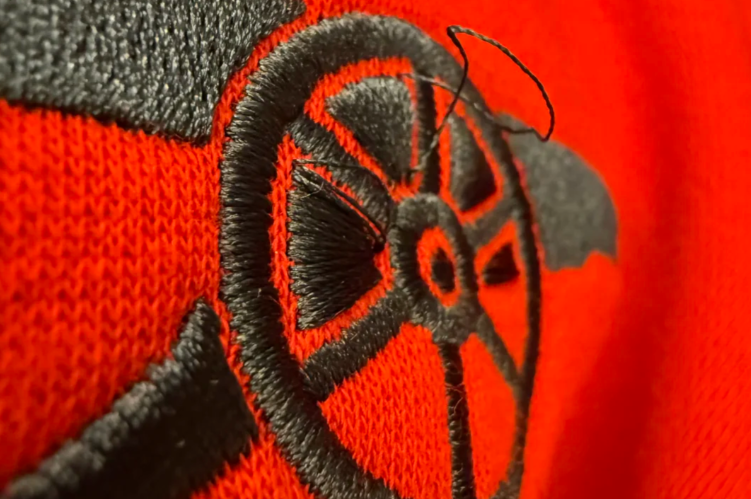
Poorly digitized files may have too many stitches (causing the fabric to become stiff and “bulletproof”) or too few (leading to the fabric showing through the design). For sports promotional items like knit scarves, the digitizer must account for the “stretch” of the material.
2. Common Technical Failures & What Causes Them
A. Puckering (The “Wrinkle” Effect)
Puckering is that unsightly gathering of fabric around the embroidered area. It’s particularly common on lightweight promotional flags and thin nylon bucket hats.
- The Cause: High thread tension or an improper choice of “backing” (the stabilizer material behind the fabric).
- The Risk: It makes the product look cheap and poorly manufactured, even if the fabric itself is high-quality.
B. Registration Errors (The “Shift”)
If your logo has an outline and that outline isn’t perfectly aligned with the fill color, you have a registration error. This is a nightmare for brands with strict visual identity guidelines.
3. Product-Specific Challenges
The Fan Scarf: The “Sinking” Text
Sports scarves are usually knit. Knitted fabrics have “loops” and “valleys.” Small text tends to fall into these valleys and disappear.
The Solution: We recommend a minimum font height of 5-6mm for knitwear and the use of “water-soluble topping” during production to keep the stitches sitting high on the surface.
The Bucket Hat: The Seam Battle
Bucket hats are made of panels. If a logo is placed directly over a seam, the needle may deflect, leading to crooked stitches or broken threads.
4. Real-World Case Studies
Case Study 01: The “Vanishing” Latin Motto
Client: A European Football Club’s Merchandising Team.
Product: 10,000 Acrylic Knit Scarves.
The Issue: The club’s crest included a Latin motto in 3mm high letters. In production, the motto became a solid line of thread that looked like a mistake.
The Fix: We worked with the procurement team to “simplify” the crest for embroidery—removing the motto and slightly enlarging the central icon. The final product was bold, recognizable, and stayed within budget.
Case Study 02: The Distorted Flag Logo
Client: A Corporate Sponsor for a Golf Tournament.
Product: Large Polyester Event Flags.
The Issue: The client insisted on a massive, 30cm wide fully-filled embroidered logo. The weight of the 50,000 stitches made the light polyester flag sag and prevented it from waving in the wind.
The Fix: We suggested an Appliqué method (sewing a pre-embroidered patch onto the flag) combined with “outline embroidery” to reduce the stitch count by 60% while maintaining the “premium” look.
5. Quality Control Checklist for Procurement
Before you sign off on a mass production run, ensure your supplier meets these criteria:
| Checkpoint | Requirement | Why it matters |
|---|---|---|
| Stitch Density | Consistent, no “show-through” | Prevents the logo from looking thin or cheap. |
| Thread Trimming | No “jump threads” between letters | Manual trimming indicates a high-end finish. |
| Backing Material | Trimmed close to the logo | Ensures comfort (for hats) and aesthetics (for scarves). |
| Color Matching | Pantone to Thread Conversion | Ensures brand consistency across different media. |
Planning Your Next Fan Activation?
Don’t let technical embroidery issues ruin your brand’s big moment. Our team specializing in sports promotional items is here to help you audit your designs for production success.