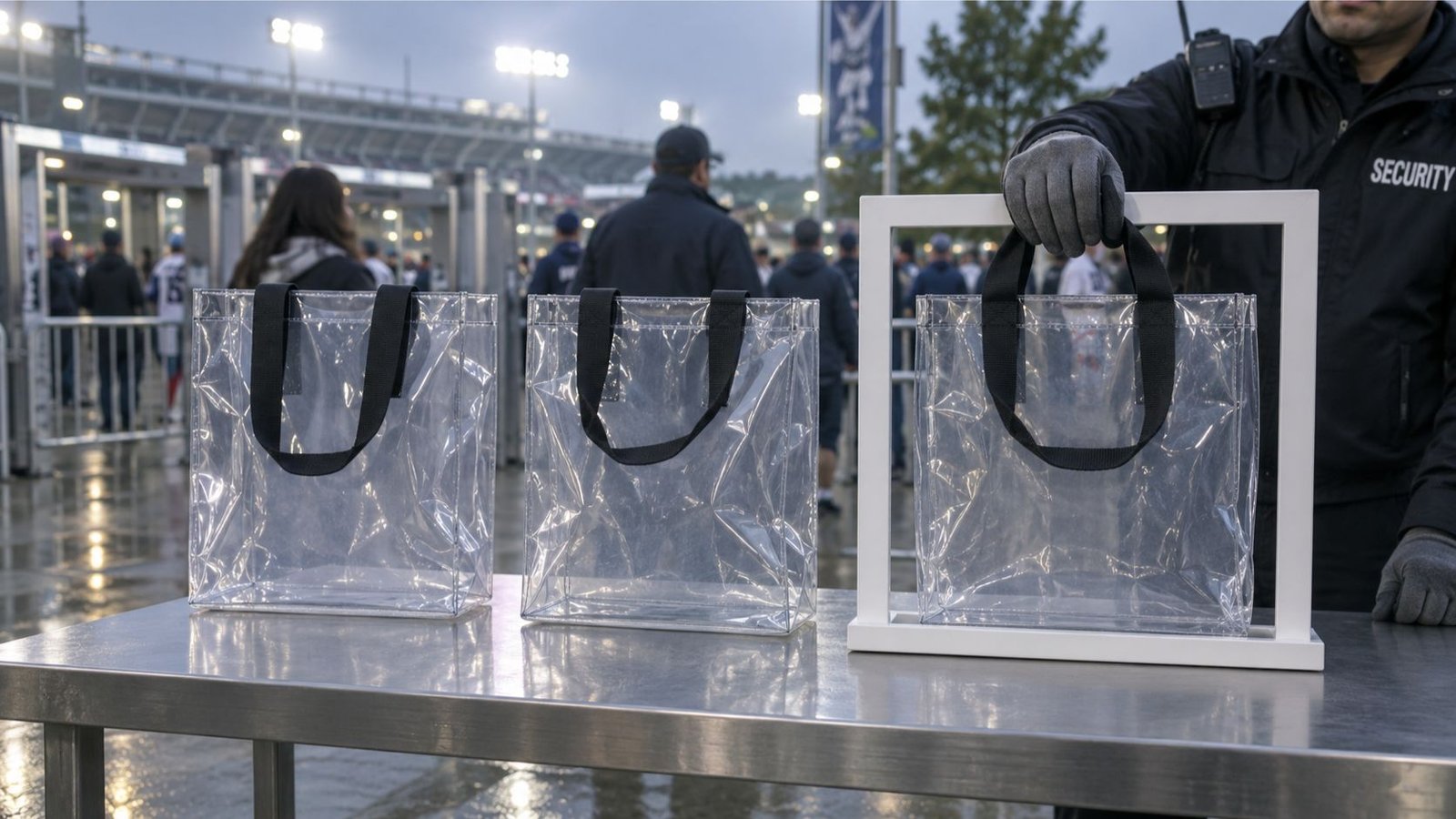
Three stadiums. Three clear bags. One purchase order.
At the first gate the bag passes the sizer box without a second look. At the second it does not fit, because filled with a hoodie and a one-litre bottle it bulges past the six-inch depth. At the third the bag is not permitted at all: Raymond James Stadium in Tampa allows one clutch no larger than 4.5 by 6.5 inches — which does not have to be clear — and no other bag of any kind.
All three were bought as stadium approved.
That phrase is the problem. It is not a standard, a test or a certificate. It is promotional shorthand for a hope: that the bag will be accepted at the venue the buyer had in mind, on the day the buyer had in mind, enforced by a security guard who has never seen the purchase order.
The good news is that bags are one of the few categories where the requirement is published. The work is not guessing what the venue wants. It is translating a venue rule into film, seam and print specifications — and knowing which parts of the rule are decided by a person at a gate.
The short version
- “Stadium approved” has no certifying body. Enforcement sits with venue security, and league policy is guidance they apply with discretion.
- 12 × 12 × 6 and 12 × 6 × 12 are the same bag. The order of the numbers changes between product pages and policy documents, not the product.
- Measure the bag filled, not flat. A soft tote bulges past its nominal depth once it holds a hoodie, and the sizer box has no give.
- Film thickness is the specification most often mislabelled, and the carton weight is the fastest way to audit it without a micrometer.
- Cold is the failure mode nobody tests for. Flexible PVC does not fail in summer; it cracks at a fold in January.
- If the artwork covers the panel, the bag stops being clear in the only sense that matters: what the screener can see.
“Stadium Approved” Is a Phrase, Not a Certificate
There is no register of approved bags and no laboratory issues a certificate. What exists is a bag policy published by each league and each venue, revised every season, and enforced by staff who have a plastic box at the gate and the authority to use their judgement.
The National Football League’s policy is the most widely copied, and it is short. Clear bags must be plastic, vinyl or PVC and must not exceed 12 by 6 by 12 inches (30.5 by 15.25 by 30.5 centimetres). A one-gallon clear freezer bag is also accepted. A small bag of 4.5 by 6.5 inches may be carried in addition. Medically necessary items are allowed after inspection and tagging at a designated lane.
Then comes the sentence that matters more than the dimensions: the league reserves the right to refuse entry of certain items if security believes they are inappropriate.
That is the category in one line. The dimensions are written down; the interpretation is not. (We cover the same logic for flags, wearables and accessories in the stadium compliance guide; bags are where the rule is easiest to check and most often ignored.)
It also means there is no universally compliant bag. Policies fall into four rough tiers, and the tier decides whether a clear bag is even the right product.
Table 1 — Four tiers of venue bag policy
| Tier | Typical venues | What is allowed | Upper limit | What it means for a clear-bag program |
| 1 | Some NFL and NBA venues (e.g. Raymond James Stadium) | One small clutch, often no bag at all; clear bags not accepted | 4.5″ × 6.5″ | A 12 × 12 × 6 giveaway is a gate rejection here |
| 2 | Most NFL stadiums, college football | One clear bag plus a small clutch | 12″ × 6″ × 12″ | The core clear-bag market |
| 3 | Many NBA arenas and MLS stadiums | Clear bag preferred; small non-clear bags also allowed | ~14″ × 14″ × 6″ | Clear bag is a nice-to-have, not a requirement |
| 4 | Most MLB ballparks | Soft-sided single-compartment bags | ~16″ × 16″ × 8″ | Clear bags compete with ordinary totes |
A club should spec to the strictest gate on its own schedule, not to the average — the average does not exist. And the line that belongs in the purchase order is not “stadium approved” but the venue’s own written rule for that season, plus the internal dimensions of the sizer box at the gate.
Ask for that box measurement in writing. It is a strange request, and it is the only one that survives contact with a security supervisor on game day.
The Measurement Trap
Buyers spend a surprising amount of time on a question with no content: is the bag 12 × 12 × 6 or 12 × 6 × 12?
They are the same bag. The policy writes depth second because it is thinking of a bag lying flat on a table; the product page writes the same three numbers in the order a cutter would. Nothing differs except the sequence.
The number that does have content is volume. Twelve by six by twelve is 864 cubic inches, about 14 litres. A one-gallon freezer bag is 231 cubic inches, about 3.8 litres. The tote the league describes is nearly four times the volume of the bag most fans bring — which is why clubs buy totes, and why the tote has a problem the freezer bag does not: it gets filled. (The same nominal-versus-real capacity gap runs through cooler bags, where the number on the quote and the ice that fits are rarely the same.)
A soft bag has no fixed shape. Load it with a folded hoodie, a water bottle and a programme and the side gusset pushes outward; a bag cut at six inches of depth measures closer to six and a half once it is full, and the sizer box is rigid. The bag does not fail because it was made wrong. It fails because it was measured empty.
The fix is a specification line most suppliers will not volunteer: filled dimensions. Ask for the external dimensions of the bag packed to its intended working load, and ask how the gusset and base corners behave under that load. A factory that can only quote flat dimensions has not built this product often enough to know where it goes wrong.
The 0.25 Millimetre Question
Film thickness is where clear-bag quotes diverge, and where the vocabulary collapses.
Three units circulate: gauge, mil and millimetre. In polyethylene film one mil equals one hundred gauge, so a “one mil” liner is “100 gauge”. Vinyl suppliers borrow the word without the convention, and the same “10 gauge” bag has been described as 0.10 mm, 0.25 mm and ten mil by different factories. None of them were lying. They were using a word that means nothing on its own.
Ask for millimetres, and ask where the measurement was taken. Film thins at a weld: a bag specified at 0.25 mm that measures 0.25 in the body and 0.21 on the seam is a normal bag; one that measures 0.21 everywhere is a substitution.
The clear tote in our range is 0.25 mm PVC. In promotional clear bags, 0.20 to 0.25 mm is the working range: enough body to hold a shape, thin enough to fold flat and ship cheaply. Retail programs move to 0.30 mm and above because a bag sold at retail is handled, refolded and judged by feel — the zippered PVC tote is the same 12 × 12 × 6 geometry built for that treatment.
Thickness is not stiffness. Stiffness comes from the plasticiser system, not the calliper: a 0.35 mm bag with a heavy plasticiser load can feel floppier than a well-formulated 0.25 mm one, and it is the heavy one that goes tacky in a warehouse in August.
There is a way to audit all of this without a micrometer, using the only document every factory already sends you: the carton.
Table 2 — Reading the film off the carton weight
| Line | Value | Where it comes from |
| Carton gross weight | 30.8 lb / 13.97 kg | Shipping mark |
| Units per carton | 100 | Packing list |
| Gross weight per unit | 139.7 g | 13.97 kg ÷ 100 |
| Carton tare | ≈ 11 g per unit | 1.1 kg carton ÷ 100 |
| Polybag | ≈ 5 g per unit | Sample |
| Bag mass | ≈ 124 g | Remainder |
| Handles, thread, zip pull | ≈ 7 g | Sample, on a scale |
| Film mass | ≈ 117 g | Remainder |
| Film area, 12 × 12 body, 6″ gusset, 10% seam allowance | ≈ 0.36 m² | Geometry |
| Film grammage | ≈ 325 g/m² | 117 g ÷ 0.36 m² |
| Implied thickness | ≈ 0.24 mm | 325 g/m² ÷ 1.35 g/cm³ |
The arithmetic lands within a hundredth of a millimetre of the specification. That is what a specification is supposed to do: predict a physical quantity someone else can verify with a scale.
Run it in reverse on a competing quote. If the price is 30% lower and the carton weight implies 0.18 mm, you have found the difference before the pallet arrives. If the supplier will not give you a carton weight, that is also information.
Cold Is the Test Nobody Runs
Flexible PVC does not fail in July. It fails in the fourth quarter, in an open-air stadium, when the bag has spent the night in a car and forty minutes in a queue at 2°C.
The failure is not that the film goes hard. It becomes brittle: a crease that would flex in summer cracks, and the handle attachment — already the highest-stress area in the bag — tears instead of stretching.
Whether that happens is decided by the plasticiser system, which is the same variable that decides whether the bag feels soft, smells of chemicals, or turns tacky on a shelf. Cheap plasticiser buys softness and cold-fragility together, which is why “it cracked” and “it went sticky” so often arrive from the same shipment.
The test that settles it is ASTM D1790, brittleness temperature of plastic sheeting by impact. Ask for the report, not the number.
We do not publish a single brittleness temperature across our clear-bag range, because the result belongs to a formulation and a film lot rather than a product family — and a number quoted without a report behind it is a marketing number. What is worth insisting on before a winter program goes to bulk: a report on the film lot actually in use, and a frozen-fold check on the production sample.
The frozen-fold check is the buyer’s version, and it takes an evening. Put three bags in a freezer at −10°C for four hours. Fold one hard along the gusset within ten seconds of taking it out and look at the crease. Hang the second from its handle with five kilograms inside and time how long the attachment takes to yield. Fill the third and drop it from waist height onto concrete. Any of the three failing tells you what January would have told you, at the cost of three bags.
The Seam Is the Weakest Line
A clear bag has two possible constructions, and only one of them is honest about its weaknesses.
Radio-frequency welding fuses two layers of PVC into one. There is no thread, no needle hole and no path for water; the seam is usually stronger than the film around it. It also produces the category’s most expensive defect: the false weld. When die pressure, dwell time or film gauge is off, the seam looks perfect and peels at a quarter of the expected load. Nothing about the bag’s appearance predicts it.
Stitching is older and cheaper at small quantities. Every needle hole is a stress riser in a material with low tear strength, so a stitched clear bag lives or dies on details a buyer cannot see in a photo: two rows rather than one, backstitching at the ends, and a reinforced patch where the handle meets the body.
There is also a detail that separates suppliers who have made this product from suppliers who have quoted it. On a stitched clear bag, the thread has to be clear. A white or black thread draws a visible line through the panel and undoes the reason the bag exists. It is a trivial cost difference and a constant failure in low-cost sourcing.
The check is a peel test. Grip the seam on both sides and pull until something gives: a good weld tears the film beside the seam and leaves the seam intact, a false weld opens along the join, and a good stitch breaks the film at the needle line — which is why the reinforcement matters more than the stitch.
The Handle Is Where They Tear
Every clear bag fails at the same place. Film has low tear strength, webbing has high tensile strength, and the handle is where the two are asked to cooperate.
The construction that survives a season has three parts: webbing wide enough to spread the load (3 cm is the working standard for a filled tote, 2.5 cm is the cost-reduced version), an X-box stitch or bar-tack rather than a single row, and a reinforced patch or an extended weld footprint so the load enters the film over an area rather than at a point. None of the three is visible in a product photo, which is why handle construction is one of the more reliable signals of what a quote actually contains.
What belongs in a specification is the construction and the test protocol, not a single load figure, because a load number without a protocol is not comparable: “holds 20 kg” means nothing without saying for how long, from which point, and with what damage threshold. The protocol worth writing into a purchase order is three times the expected working load, suspended for ten minutes, with no visible tear at the attachment and no permanent deformation. Ask any supplier for the same three numbers, and you will get either a protocol or an adjective.
Printing on Something You Can See Through
Printing clear film is the opposite of printing fabric. There is no ground colour to hide registration error, no absorbency to soften an edge, and nothing to hide a thin ink film.
White comes first. A logo printed directly onto clear PVC is not white; it is a translucent grey that changes with whatever is behind it. Every opaque colour sits on a white underbase, and the number of white passes is the difference between a logo that reads at ten metres and one that looks dirty. Ask how many.
Placement trades off against itself. Printing on the inside protects the ink from abrasion, but the ink is then viewed through the film and the contents add their own colour behind it. Printing on the outside gives a cleaner white and needs a varnish or a heavy ink film to survive handling.
Which process you get depends on the artwork and the run length, not on a house preference. Large solid colours and long runs go to screen printing, where ink deposit is generous and the white blocks properly. Fine detail, gradients, photographic elements and short runs go to UV digital, where there is no screen to burn and no setup cost sitting on the first hundred pieces. A factory that can only offer one of the two is telling you what its equipment can do, not what your artwork needs — and if a program is split across two suppliers to hit a date, the whites will not match, which is the failure described in our note on split sourcing.
Two tests matter more than any of this. Adhesion: press 3M tape onto a cured print and pull; ink that lifts is ink that will lift in a fan’s bag. Blocking: stack printed bags, load them at 40°C for 24 hours and see whether they fuse. Plasticiser migration softens ink over time, so a bag printed in June and shipped in September can arrive with a print that has started to smear — a defect no final inspection catches, because it develops in the carton.
And one rule that is not a test: leave a panel clear. A policy that says “clear” is enforced by a person who has to see what is inside. A bag wrapped in full-bleed print invites the screener’s discretion, which is the one thing the dimensions were supposed to remove. Keep the logo on the lower third or the gusset, keep the front panel transparent.
Who Is Actually Buying This Bag
Three buyers, three specifications, and the differences are not cosmetic.
The venue giveaway is the volume program: 5,000 to 50,000 pieces, one or two colours, 0.20 to 0.25 mm film, packed loose or in polybags, and one hard requirement — it must pass the box at that venue. Print is minimal because the bag’s job is to be accepted, then to be used.
The club retail program is a different product at a different price: 0.25 to 0.30 mm film, retail-ready packing with a header or hangtag, a barcode, and a hand feel that survives being picked up in a shop. The stadium clutch is the small-format version of the same decision, and the clear backpack is the version where strap attachment, not film, decides the returns rate.
The sponsor program wants the contradiction resolved: maximum printed area on an object whose entire value is transparency. The answer is hierarchy — a clear panel for the security check and the fan’s own view, a printed band for the brand.
One commercial fact is worth planning around. Bag policies are reissued each season and venues move between tiers, so a club that bought 30,000 bags against one set of rules and then saw its venue tighten them is holding inventory that cannot be given away. Split the buy: a first drop sized to the opening weeks, a second after the policy cycle settles. The freight saving from one consolidated shipment is rarely worth the write-off.
The other side of the same fact is that clear bags are one of the few genuinely recurring categories in sports merchandise — and the reorder rarely matches the original, for the reasons we went through in the reorder problem.
Ten Questions for the Next Clear-Bag RFQ
- What is the film thickness in millimetres, measured in the body and at the seam?
- Is the film PVC, TPU or EVA — and if PVC, is the plasticiser phthalate-free?
- Is there an ASTM D1790 brittleness report for the film lot, and can we see it before bulk?
- Are the quoted dimensions flat or filled, and how does the gusset behave under load?
- Is the bag welded or stitched, and what peel strength does the seam hold?
- What is the handle width, the stitch pattern and the reinforcement at the attachment?
- How many white passes, and what are the adhesion and blocking test results?
- Does the print leave a clear panel, and which panel does the venue’s screener see?
- Which test reports come with the shipment — phthalates, heavy metals, or both?
- What is the carton gross weight and unit count, so we can verify the film ourselves?
If the answers to five, seven and ten are adjectives rather than numbers, the quote is not yet a specification. It is a price.
The Bottom Line
A clear bag is the only product in sports merchandise whose specification is written on a wall at the venue, in a document reissued every season, and enforced by a person holding a box.
That makes it unusually easy to buy well and unusually easy to buy badly. The dimensions are public. The film thickness is verifiable with a scale. The seam, the handle and the white underbase are all decisions that exist before the price does. What is not public is the discretion at the gate — which is why the specification that matters is the one that keeps the bag visibly clear and measurably the right size.
At J&F, we produce custom clear bags, totes, backpacks and stadium clutches for teams, clubs, sponsors, agencies and event organisers, alongside flags, scarves, headwear, towels and fan gift programs. If you are building a clear-bag program, send us the venue, the season, the quantity and the artwork. We will come back with the film gauge, the seam method, the filled dimensions and the price for each — plus the one number your venue’s sizer box will actually check.