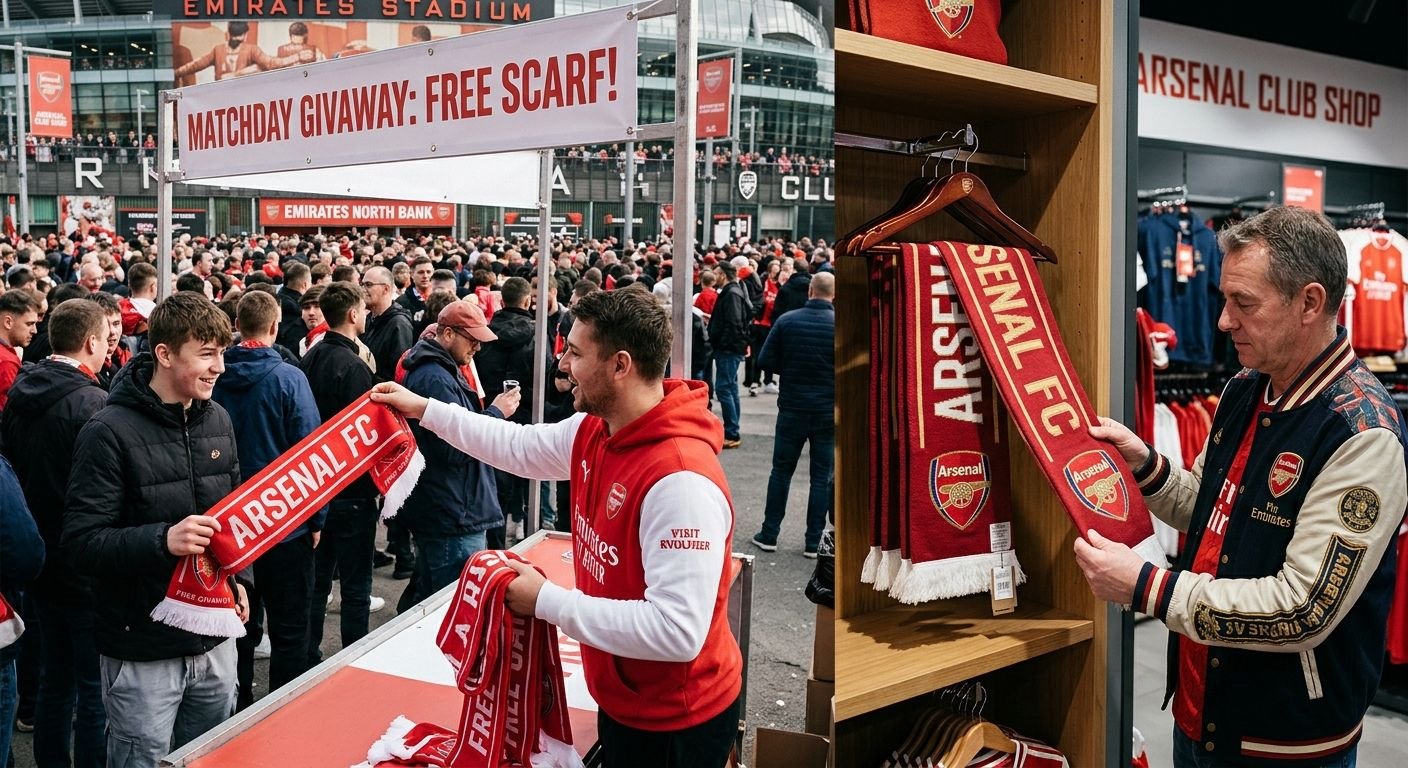
Two pallets leave the same factory on the same afternoon. Both hold the same scarf: 4,000 pieces, 180 by 25 centimetres, two-colour jacquard, a knitted wordmark at each end.
One pallet is a gate giveaway. It will be handed to fans in the ninety minutes before kick-off, worn for one cold afternoon, and forgotten. The other is going to a club shop, where it will hang on a rail at €39, be picked up and put down fifty times, and come back to the counter if the wordmark sits two millimetres off centre.
The scarf is identical. The risk is not.
Most buyers inspect both pallets the same way, with the same standard, the same level and the same AQL, because that is what the supplier’s template says and what the last program used. It is not laziness exactly. It is the absence of a decision nobody was asked to make.
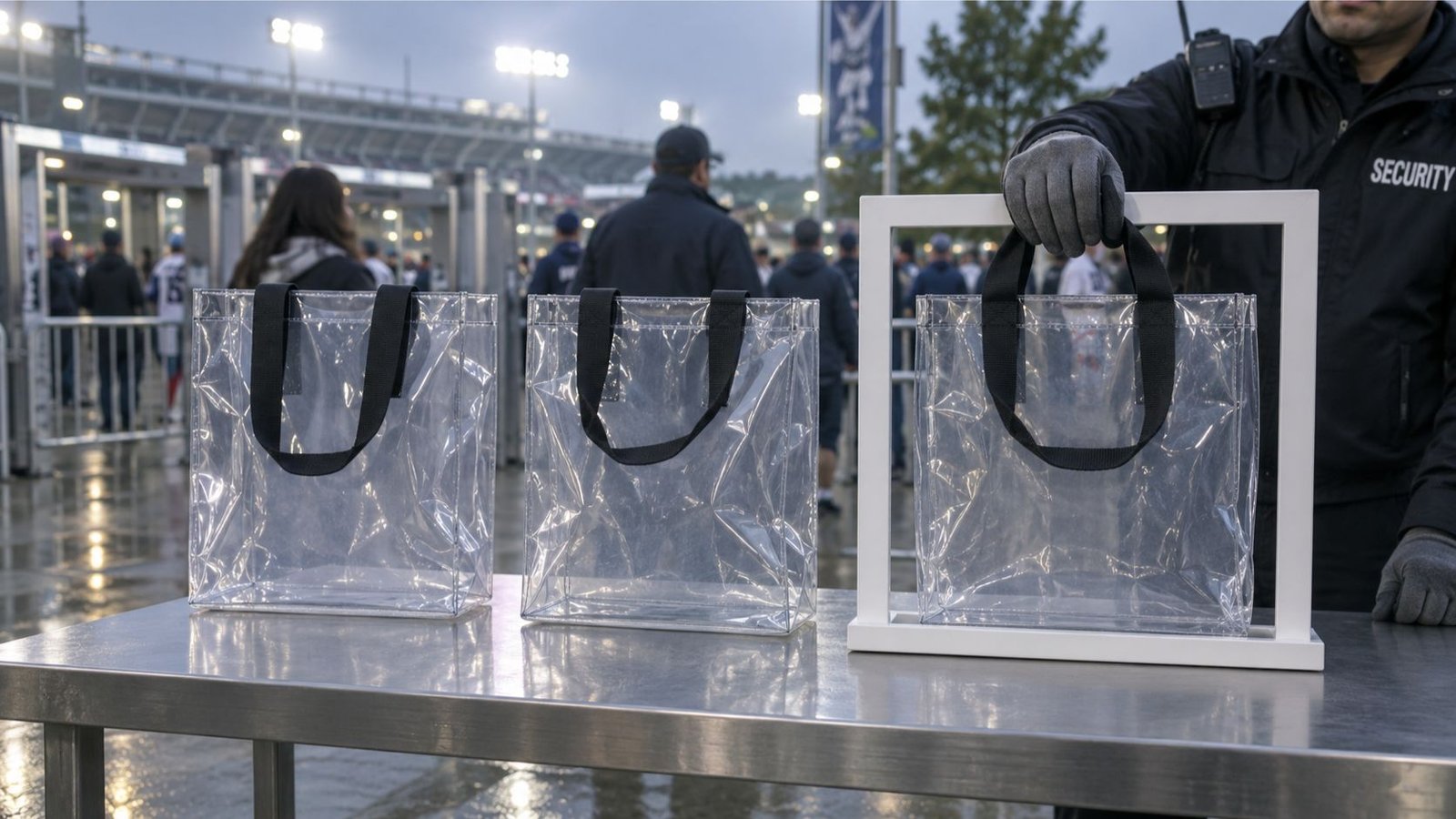
That decision is the whole subject of this article — the same way the venue, not the product, sets the specification for stadium-approved clear bags. AQL is not a quality level. It is a price you put on a defect — and the price depends on where the product is going, not on what your supplier habitually writes in the header of a form.
The short version
- AQL is a business decision, not a quality target. Tightening it does not make the factory better; it changes who pays for the risk.
- The same product should be inspected to different standards for a giveaway, a retail program, a licensed product, a sponsor gift and anything a child might put in their mouth.
- Defect classification matters more than the sampling level, and it is decided by the buyer in the purchase order, not by the inspector at the table.
- The report is the actual product of an inspection. Without fixed fields, “quality is OK” is an opinion.
- Final inspection can only reject. In-line inspection, at 30–50% of production, can still change something.
- Name your defects. A log of names is comparable across runs; a count of “minor defects” is not.
AQL Is a Price on Consequences
The formal definition is dull and worth saying once: AQL is the maximum percentage of defective units that, for sampling purposes, can be considered acceptable as a process average. It describes a trade between two risks — shipping something bad, and rejecting something good — not a level of craftsmanship.
The practical definition is better. AQL is the amount of risk you are willing to carry in exchange for not inspecting every unit.
Which means tightening it has a price, and that price does not disappear. Raise the standard from 2.5 to 1.0 and the same production run yields more rejections, more sorting, more rework, more air freight — and a supplier who has done this for a decade will price it in next season. A buyer who thinks a lower AQL number is free has not yet received the quote.
So the question is never “how strict should we be”. It is three questions:
- What does this defect actually do to the person who receives it?
- Who absorbs the consequence — the fan, the retailer, the sponsor, or the legal team?
- How late will we find out, and what does late cost?
A scarf that sheds a loose yarn end on a fan’s coat at a giveaway is a small annoyance. The same yarn end, on a scarf in a retail polybag with a hangtag, is a return. The same yarn end inside a gift box handed to a sponsor’s guest is a photograph on social media.
Set the Plan by Use
The matrix below is the argument of this article in one table. It is not a standard, and no committee approved it. It is a way of reasoning that produces a defensible plan instead of an inherited one.
Table 1 — Choosing a plan by use
| Where the product goes | What a defect actually costs | Suggested plan (ISO 2859-1, Level II) | What has to be added |
| Safety or children’s items (mouth contact, under-14 users) | Injury, recall, regulatory exposure | Critical 0 + major at 0.65; safety attributes 100% checked | CPSIA / REACH reports, small-parts test |
| Licensed or IP-bearing merchandise | A wrong mark is a legal problem and a scrapped run | Critical 0 + major at 1.0 | Colour-by-colour check against the approval sample |
| Retail (club shop, online store) | Returns and shelf judgement | Critical 0 + major 1.0 / minor 2.5 | Individual packing, barcode, colour difference |
| Event giveaway (gate handout) | A disappointed fan, low unit cost | Critical 0 + major 2.5 / minor 4.0 | Quantity and date outrank cosmetics |
| Sponsor gift or VIP box | Brand damage in front of guests | Critical 0 + major 1.0 / minor 2.5 | Unit-by-unit check, assembly against the packing list |
| Structural or load-bearing items (flags in wind, bags that carry) | Field failure, injury, claim | Critical 0 + major 1.0 | Functional test: pull, wind load, seam |
The cleanest way to see what the table means is to watch one defect change class as the destination changes.
Take a cuff seam that has not been backstitched. On a giveaway scarf it is minor: the seam holds for an afternoon, the fan never notices, the run ships. On a retail scarf it becomes major, because the second pull at the counter is the one that opens it. On a knitted product intended for children it becomes critical, because a seam that opens is a loop of yarn in a small hand.
The defect did not change. The consequences did. Classification is a statement about use, not about workmanship.
What We Run
For general promotional programs we work to ISO 2859-1, general inspection level II, with major defects at AQL 1.0 and minor defects at AQL 2.5. Critical defects are accepted at zero, always.
That pairing is deliberate. Major is two and a half times stricter than minor because a functional failure and a cosmetic blemish do not deserve the same tolerance. A program that applies one AQL to everything is quietly saying that a broken seam and a stray thread are equally serious, which is never true.
Table 2 — Our sampling plan (Level II, major at 1.0, minor at 2.5)
| Lot size | Sample size | Major allowed | Minor allowed |
| 501–1,200 | 80 | 2 | 5 |
| 1,201–3,200 | 125 | 3 | 7 |
| 3,201–10,000 | 200 | 5 | 10 |
| 10,001–35,000 | 315 | 7 | 14 |
| 35,001–150,000 | 500 | 10 | 21 |
| 150,001–500,000 | 800 | 14 | 21 |
| Over 500,000 | 1,250 | 21 | 21 |
Publishing this table is a commitment, and we publish it anyway, because a buyer cannot compare suppliers who each keep their own arithmetic private. Contract terms take precedence for specific programs, and unusual categories can be agreed separately — but the default should be a number, not a conversation.
Two things about the table are worth pointing out, because they are where plans go wrong in practice.
The first is the step at 3,200 pieces: the sample jumps from 125 to 200 and the allowance moves with it. A buyer who splits a 4,000-piece order into two lots of 2,000 has not simplified anything — 250 pieces will be inspected instead of 200, and two allowances of three majors will replace one allowance of five. Splitting a lot is not a neutral act.
The second is that the sample size is not a budget item. We have been offered “we will inspect 50 pieces instead of 125 to keep the inspection cost down” more than once. That is not a discount; it is a different plan with a different risk, and it should be written down and accepted as such, not quietly substituted.
The Report Is the Product
An inspection produces two things: a decision and a document. Most buyers remember the decision and lose the document. The document is the one that survives — it is what you send when the pallet arrives with the wrong carton marks, what you quote when the same defect appears in run two, and what you hand to a new supplier as the standard they have to beat.
Below is a composite report, anonymised and rebuilt for this article — the product, the numbers and the defects are illustrative, the structure is the one we use.
Table 3 — Twelve fields, and what each one prevents
| Field | The composite report says | What it prevents |
| PO and date | PO-26-0418 / 2026-11-03 | Inspecting “a batch” instead of one order |
| Product, quantity, finished quantity | Jacquard scarf, 4,000 pcs / 4,000 finished | Accepting 80% of a run as if it were finished |
| Stage | In-line ☐ / Final ☑ | Finding a problem after the only moment you could fix it |
| Subcontracted? | Yes ☐ / No ☑ | Inspecting the wrong building |
| Approval sample | A/S: ☑ Yes, ref. SC-118 | Arguing about “the sample” with no sample |
| Defect list with names | Loose yarn end — 5 (minor); Oil spot — 2 (minor); Crest edge puckering — 2 (major) | A report that says “5 minor defects” and teaches nothing |
| Classes and allowances | Critical 0 / Major 5 / Minor 10 | A threshold invented at the table |
| Standard and level | ISO 2859-1, Level II | An inspection nobody can reproduce |
| Sample size | 200 | A sample size chosen for the calendar |
| Bench tests | Function, tape, rub, seam, colour — all OK | Cosmetic checking with no functional evidence |
| Carton numbers drawn | Cartons 12, 47, 88, 131, 152 | A report no third party can re-check |
| Photo record | 5 pages: carton, packing, marks, product, defects | A dispute with no evidence |
The composite totals: 0 critical, 2 major, 7 minor against allowances of 0, 5 and 10. The report reads “pass”. The interesting part is not the verdict — it is that every number in it can be argued with, checked or reproduced, which is exactly what “quality is OK” cannot do.
A note on the photo record. In our reports the photographs usually outnumber the text. That is not decoration. When a buyer says the cartons arrived crushed, the photo of the carton at the factory is the difference between a claim and a conversation. (The stadium compliance guide makes the same case from the other direction: rules you cannot check are rules you cannot enforce.)
The ALLOW Row Ends the Argument
The single most important line on the form is not the total found. It is the allowance — 0, 5, 10 — written before production started.
With the allowance fixed, acceptance is arithmetic: seven minor defects against ten allowed is a pass, and nobody has to have an opinion. Without it, acceptance becomes a negotiation conducted at the end of a loading dock, by the two people with the least power to change anything.
Two practical rules follow. First, the allowance belongs in the purchase order, next to the specification, not in a template the supplier fills in later. Second, someone has to sign for the classes: a critical defect is not a judgement call to be made at 11pm by an inspector who has been awake since six.
Defects Need Names
The composite lists “loose yarn end — 5” rather than “minor — 5”, and that distinction is worth more than it looks.
A named defect is comparable. If run two also shows five loose yarn ends, the process has not changed. If it shows fourteen, something changed — a new operator, a faster line, a different yarn lot — and the number tells you where to look. (The same discipline is what makes a reorder comparable to its first run.) A count of “minor defects” cannot do that, because it merges five unrelated failure modes into one number that never moves.
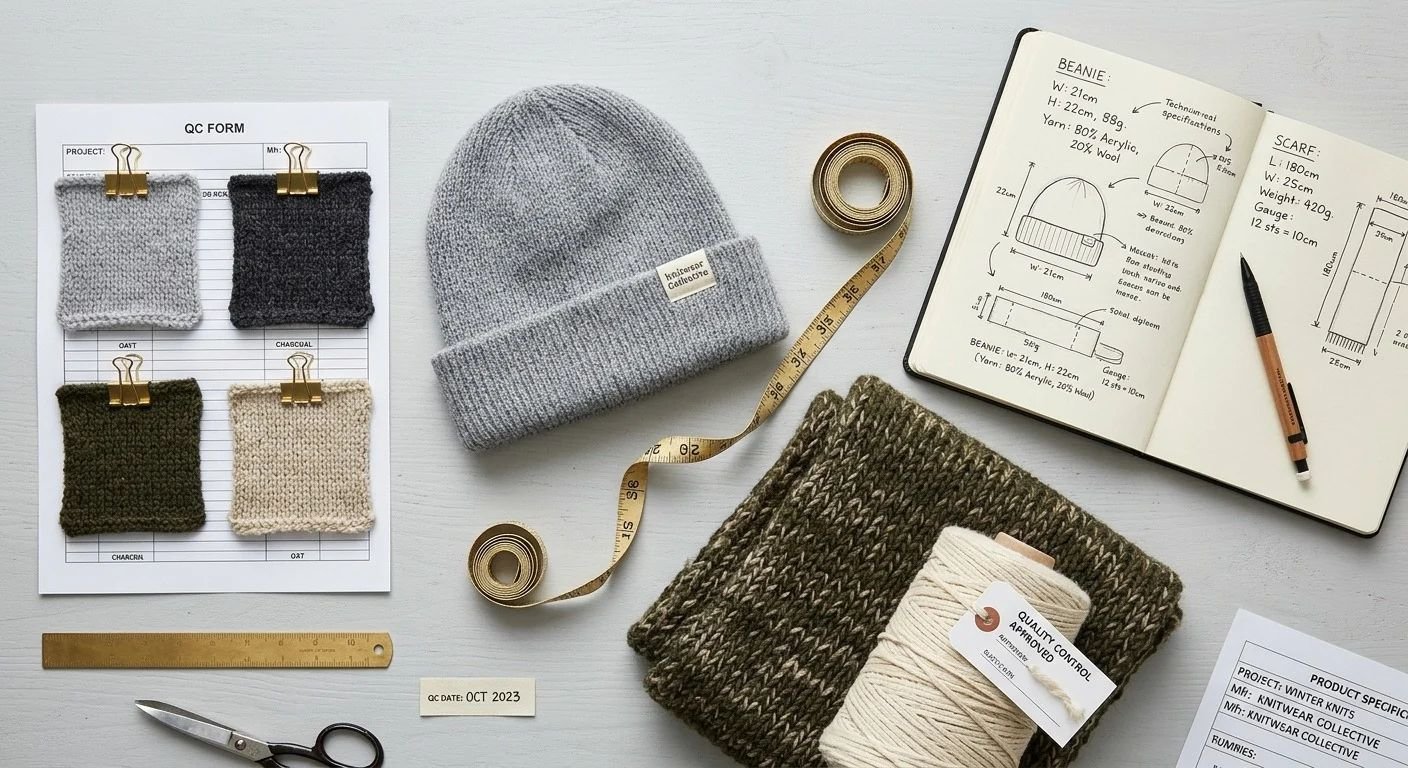
The practical version is a defect code list of ten to twenty entries, shared between buyer and factory, with a photograph and a one-line definition for each. It takes an afternoon to write and it turns every future report into a dataset. We keep one per product family; the list is the reason a report from eighteen months ago is still useful.
Five Tests AQL Cannot Replace
Sampling tells you how many units to look at. It says nothing about what to do with them, and five things cannot be settled by looking at all.
- Function. For a scarf, that means length after relaxation, cuff recovery, and whether the jacquard pulls. For a flag, it means deployment, rotation and the pole lock — the tests that matter far more on a hand flag than on a printed rally towel. A unit that looks perfect and fails here is a critical defect wearing a minor defect’s clothes.
- Print adhesion. Press tape onto a cured print and pull. Ink that lifts is ink that will lift in a fan’s hands.
- Rub resistance. A fingernail or a coin, dragged at a consistent pressure for a consistent number of strokes. Cheap, reproducible, and the closest thing to how a product actually wears.
- Seam strength. Grip the seam on both sides and pull five centimetres. A good seam tears the fabric beside it; a bad one opens along the join. This is the test that separates a weld from a false weld, and a backstitch from a straight run.
- Colour. Against the approval sample, or with a spectrophotometer at ΔE 1.5 or better. Under warehouse lighting, the human eye will pass two different reds — the failure mode behind most split-sourcing colour claims.
The common thread is that all five require handling or destroying the product. No sampling plan, however strict, substitutes for them.
Inspect at 40%, Not at 100%
The composite report is marked “final”, with 100% of the order finished and packed. That is the most expensive moment to inspect, because the only remaining decisions are accept, sort or reject.
At 30–50% of production, the same inspection can still change something: stop the line, re-set the machine, re-cut a panel, add an operator at the cuff. The cost of a finding at that point is measured in hours. At final inspection it is measured in air freight, a missed date, or a discount negotiated by the buyer who is now holding the goods.
This is why the stage field is not paperwork. A report that does not say when it was taken cannot tell you whether the finding was worth anything.
The argument is not “inspect early instead of late” — final inspection still has a job, which is verifying that the fixes were made and the packing is right. The argument is that a program with only a final inspection has bought itself a veto and called it quality control.
Ten Questions for the Next Inspection
- Which standard and which inspection level, written where?
- Does the sample size match the lot size on your own table?
- Where are the definitions of critical, major and minor, and who agreed them?
- What are the allowances, and who signed them before production?
- Is there an approval sample, with a reference number?
- How are defects named, and is there a code list?
- Which cartons were drawn, and can a third party re-check them?
- Is this an in-line or a final inspection?
- Who runs the bench tests, on how many units, and where are the results recorded?
- How many pages of photographs, and of what?
If your supplier cannot answer three of these, the inspection is a ritual. If they cannot answer eight, you are the inspection.
The Bottom Line
Acceptance is not a number you inherit from the last program. It is a decision about consequences: what a defect does, who it happens to, and how late you find out.
Set it by use. Write it into the purchase order. Name the defects. Keep the report. And inspect while the line can still be changed, not after the pallets are wrapped.
At J&F, we produce custom scarves, flags, headwear, bags, towels, drinkware and fan gift programs for teams, clubs, sponsors, agencies and event organisers — and we inspect them to a published plan rather than a private one. If you are setting up a program, send us the product, the quantity and where it is going: gate giveaway, club shop, sponsor gift or stadium perimeter. We will come back with the sampling plan, the defect classes and the tests we would run for that use, before the first unit is made.