Three quotes for 5,000 custom cooler bags land on your desk. One is $6.80, one is $9.40, and one is $14.20. All three say the same words: 600D oxford, insulated, leakproof.
They are not the same product, and the difference is not markup. It is four specification decisions — shell, insulation, liner, and how capacity was measured — plus a freight problem that can quietly cost more than any of them.
This guide breaks down what “cooler bag” actually means, so your next three quotes are comparable and your bag actually keeps ice.
“Cooler Bag” Is Not One Product
The category covers five different constructions, and buyers regularly compare one against another without realizing it.
| Construction | What it is | Insulation | Typical price tier | Best for |
|---|---|---|---|---|
| Soft tote | Open-top or zip tote with a thin liner | 3mm PE foam | Entry | Retail giveaways, brand merch, light use |
| Lunch cooler | Structured bag with a top zip, often with a front pocket | 3–5mm PE or EVA | Mid | Corporate gifting, employee kits, school |
| Welded leakproof cooler | Heat-welded liner, water-resistant zipper | 5–10mm, often foil-lined | Mid to premium | Tailgates, beach, marine, anywhere ice is used loose |
| Molded rigid cooler | EPP body, hard lid, like a small hard cooler | 20mm+ structural | Premium | Golf, hospitality, long-duration events |
| Backpack / sling cooler | Wearable, hands-free | 5–8mm | Mid to premium | Festivals, hiking, stadium carry-in |
The single most common mistake in this category is buying a soft tote while expecting welded leakproof performance, because both arrived under a quote that said “insulated cooler bag.”
The Four Numbers That Decide Everything
1. The shell: denier and backing
Denier measures fiber thickness, and it is the first number a buyer sees and the last one that matters on its own.
| Denier | Character | Where it belongs |
|---|---|---|
| 300D–420D | Light, thinner hand-feel, lower abrasion resistance | Budget lunch bags, light-use giveaways |
| 600D | The promotional standard — a good balance of durability and cost | Most cooler bags, most programs |
| 1000D–1680D | Heavy, structured, retail-grade | Premium programs and bags sold at retail |
Denier tells you about the outside. The backing tells you how it behaves: PU (polyurethane) backing is lighter, softer, and free of the phthalate questions attached to PVC backing, which is cheaper, stiffer, and heavier. If a quote says “600D oxford” and nothing else, you do not yet know which one you are buying.
If the denier vocabulary is new, the fabric logic in our drawstring bag fabric guide applies the same way here.
2. Insulation: material, thickness — and the two surfaces everyone forgets
Pe foam, EPE, EVA, PU foam, and molded EPP all insulate; they differ in cost, weight, flexibility, and how many millimeters you need to hit a target.
The specification detail that separates a real cooler bag from a decorated tote is not the wall thickness. It is whether the lid and the base are insulated.
Cold sinks and heat rises. A bag with 10mm walls, an uninsulated base, and a single-layer lid will underperform a bag with 5mm throughout — and the first bag is the one that appears on spec sheets with the more impressive number. Ask the question directly: what is the insulation in the base and the lid?
3. The liner: the only part that determines “leakproof”
Leakproofness is a construction, not a material, and it has two separate parts.
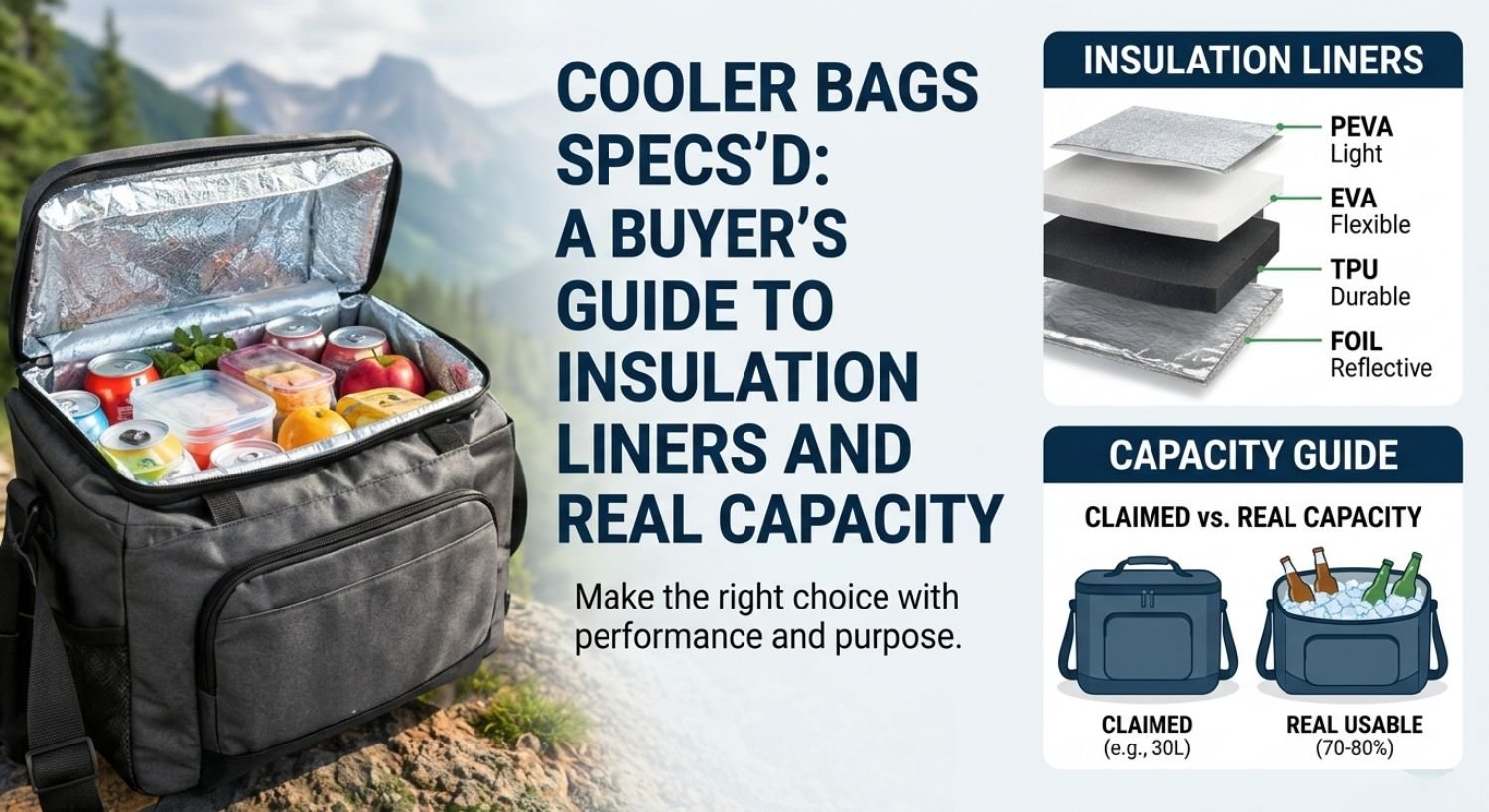
- Liner material. PEVA is the promotional standard: food-safe, PVC-free, easy to wipe out. EVA feels softer and more premium. TPU is the most durable and sits at the top of the range. PVC is the cheapest and brings odor and phthalate concerns that most brands now avoid.
- Seam construction. A sewn liner leaks through the stitch holes, every time. Only a heat-welded or RF-welded liner is genuinely leakproof.
- The zipper. This is where most “leakproof” claims quietly fail. A welded liner behind a standard zipper still leaks at the zipper. If ice will melt inside the bag, you need a water-resistant or leakproof zipper to match the liner.
4. Capacity: the “12-can” problem
Capacity numbers in this category are usually measured without ice, and often without a person holding the bag.
Here is the arithmetic. Twelve 355 ml cans is about 4.3 litres of contents. To actually cool them, you need a comparable volume of ice — call it another 4 litres — plus space for the foam walls that surround it all. So a bag that honestly holds 12 cans plus ice needs roughly 8–9 litres of usable interior before insulation.
That is why catalogue ratings and real-world performance diverge. A “12-can” rating generally means twelve cans, tightly packed, no ice. Once you add ice, you are shopping the next size up.
Two habits that prevent this problem entirely: state capacity as cans plus ice, and ask for the interior dimensions rather than the exterior ones.
Decoration: Which Print Belongs on Which Surface
Cooler bags are printed, not just branded, and the surface you choose limits the methods available.
| Method | Works well on | Notes |
|---|---|---|
| Dye sublimation | 420D–600D with a polyester face | Full-bleed, all-over designs; the best choice for bold graphics |
| Screen print | 600D oxford | Cost-effective for one to three spot colors |
| Heat transfer | Most coated fabrics | Sharp detail, good for small logos with gradients |
| Embroidery | Lids, fronts, structured panels | Premium feel on corporate and golf programs |
| PVC or rubber patch | Anywhere, as an applied element | Adds perceived value and durability |
| Woven label | Front panels, handles | Crisp small detail, retail-grade finish |
One practical note: on a coated or backed fabric, ink adhesion depends on the coating. A printer who is strong on uncoated textiles may still need a test run on your specific cooler bag fabric. Ask for a printed sample on the actual shell material, not on a swatch of something similar.
The Tests Your Supplier Should Be Able to Describe
Any factory can print “keeps cold for 24 hours.” A factory that understands the product can tell you the conditions behind that number.
Ice retention depends heavily on variables your supplier controls in the test and you control in the field:
- Fill ratio. A full cooler holds cold far longer than a half-full one, because the ice mass is larger and the trapped air volume is smaller. This is the single biggest factor, and it is why two buyers with the same bag report very different results.
- Starting temperature. Room-temperature cans and pre-chilled cans behave differently in identical bags.
- Ambient temperature. A bag tested at 22 °C is not a bag tested at 35 °C on a beach.
- Opening frequency. Every opening exchanges the cold air inside for warm air outside.
A credible test protocol states all four. If you are given a number without the conditions, you have been given a marketing claim rather than a specification.
The other tests worth asking about are simpler: a leak test (filled and inverted for a defined period), a zipper cycle test, and a drop test on the loaded bag. These catch the failures that show up in month two, after the cartons have been opened and the bags are in use.
The Freight Problem Nobody Budgets For
Cooler bags are bulky and light, which makes them one of the least efficient products to ship — and freight is often the largest variable cost in the program after the goods themselves.
Air freight is charged on volumetric weight, and ocean freight on cubic metres. A bag that cannot be flattened is billed on the space it occupies, not what it weighs. Practically:
- Bags that ship flat stow dramatically better than bags shipped pre-built, and the difference is measured in freight, not cents.
- Molded rigid coolers are the worst case: they occupy full volume with no compression option. If your program is air-freighted, this should change your construction choice.
- Carton configuration matters as much as the bag. Ask for the carton dimension and the cubic volume per 1,000 units before you compare landed costs. A smaller carton at the same unit price is often the cheaper order.
This is also why cooler bags belong in the “complex” production bracket — five to eight weeks, not two to four — and why they have to be ordered well ahead of the date they are needed. Our supply-chain calendar for early 2027 explains how a factory shutdown interacts with a category like this.
Compliance: Liners, Coatings and the 2027 Deadline
Three compliance questions come up on almost every cooler bag program, and they are worth settling before the artwork is final.
- Food contact. The liner sits against food and drink packaging. Ask for the liner’s food-contact documentation rather than assuming that a “food-grade” description covers it.
- Restricted substances. Phthalates are the reason to move away from PVC liners. Lead and other heavy metals can appear in inks and hardware. California’s Prop 65 is the most common trigger for testing requests on US retail programs.
- PFAS — and this one has a date attached. Water-repellent finishes on the outer shell and some liner chemistries fall under PFAS restrictions. California’s AB 1817 restricts regulated PFAS in textile articles from January 1, 2025, and the threshold tightens from 100 ppm to 50 ppm on January 1, 2027. If you are specifying a water-repellent cooler bag for a 2027 program, the chemistry decision is being made now, not next year.
If a supplier cannot tell you which liner chemistry they use and whether a water-repellent treatment is applied, that is not a detail — it is an open compliance exposure on your program.
Matching the Construction to the Program
| Program | Suggested construction | Capacity | Notes |
|---|---|---|---|
| Corporate gifting / employee kit | Lunch cooler, 600D, PU backing | 6–12 can | Screen print or heat transfer; embroidery on the lid for premium |
| Golf outing | Welded cooler or molded rigid | 12–24 can | Premium tier; patch or embroidery; a strong sponsor item |
| Tailgate / BBQ | Welded cooler, 600D–1680D | 24–48 can | Large print area; check the freight plan early |
| Beach / pool | Welded cooler, water-resistant shell | 12–24 can | Full-bleed sublimation; verify PFAS status of the finish |
| Marine / boat | Welded cooler, non-slip base | 24 can+ | Corrosion-resistant hardware; consider molded EPP |
| Charity sporting clays / tournament | 600D with embroidery or patch | 12–24 can | Buyers here pay for perceived value, not capacity |
| School / youth | Light lunch bag, 420D | 6 can | Budget tier; PEVA liner; simple one-color print |
What Changes on a Licensed Program
Team and league marks require authorization, and licensed cooler bags usually behave differently from giveaway merchandise in two ways.
First, they are often sold at retail rather than handed out, which raises the construction bar: retail-grade denier, a welded liner if ice is involved, clean stitching, and packaging that survives a shelf — hang tag, barcode, polybag.
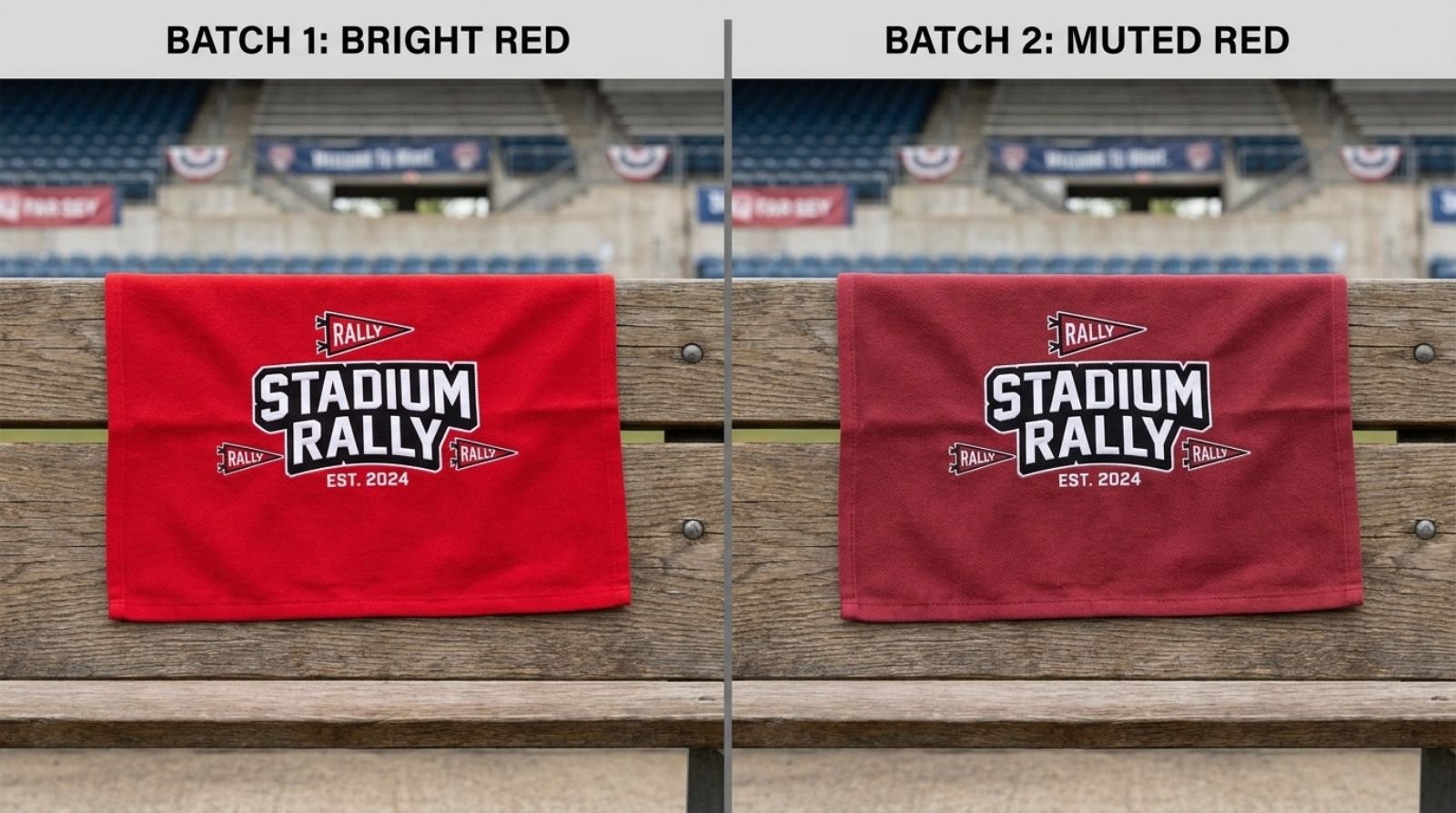
Second, the color has to hold. Coated and dyed shells are subject to the same lot variation as any textile, which makes the reorder conversation worth having before the first order ships. The full mechanics are in The Reorder Problem.
We build these for licensed programs across football and soccer, including the Pittsburgh Steelers NFL cooler bag, the Steelers jersey-shape cooler bag, the Green Bay Packers lunch cooler bag, and the LFC GEO logo lunch bag — the full range sits inside our bags and totes category.
Ten Questions to Ask Before You Order
- What is the outer fabric’s denier, and is the backing PU or PVC?
- Which insulation material, what thickness — and is the lid and base insulated too?
- Which liner material, and are the seams sewn or welded?
- Is the zipper leakproof or standard, and does it match the liner?
- Is the capacity rating measured in cans only, or cans plus ice?
- What are the interior dimensions?
- What is the ice-retention test protocol and can you share the results?
- How does the bag pack for shipping — flat or built?
- What is the carton dimension and cubic volume per 1,000 units?
- Which food-contact and restricted-substance documents come with the liner, and what is the PFAS status of the shell finish?
If you are also running a drinkware or tailgate program alongside this one, our guide to custom drinkware covers the items that usually ship in the same kit.
The Bottom Line
The gap between a $6.80 cooler bag and a $14.20 cooler bag is not margin. It is denier, insulation in the right places, a welded liner matched to a proper zipper, an honest capacity rating — and a freight plan that stops a bulky product from consuming the budget.
Ask the ten questions above before you place the order. Every one of them has an answer, and the answer is the difference between a bag that gets used all season and a bag that comes back as a complaint.
At J&F, we produce custom sports promotional products for teams, sponsors, agencies, and event organizers — cooler bags and totes, rally flags, towels, caps, knitwear, blankets, drinkware, and complete fan gift boxes. We have served teams across the NFL, MLB, NBA, and MLS since 2004, with audited factories, 25+ digital printing machines, and factory-direct air and sea freight.
If you are specifying cooler bags, send us your target arrival date, quantity, artwork, and delivery address, plus what the bag has to carry and how cold it has to stay. We will recommend the construction that actually does the job and tell you honestly what it costs — including how it will pack and ship.