
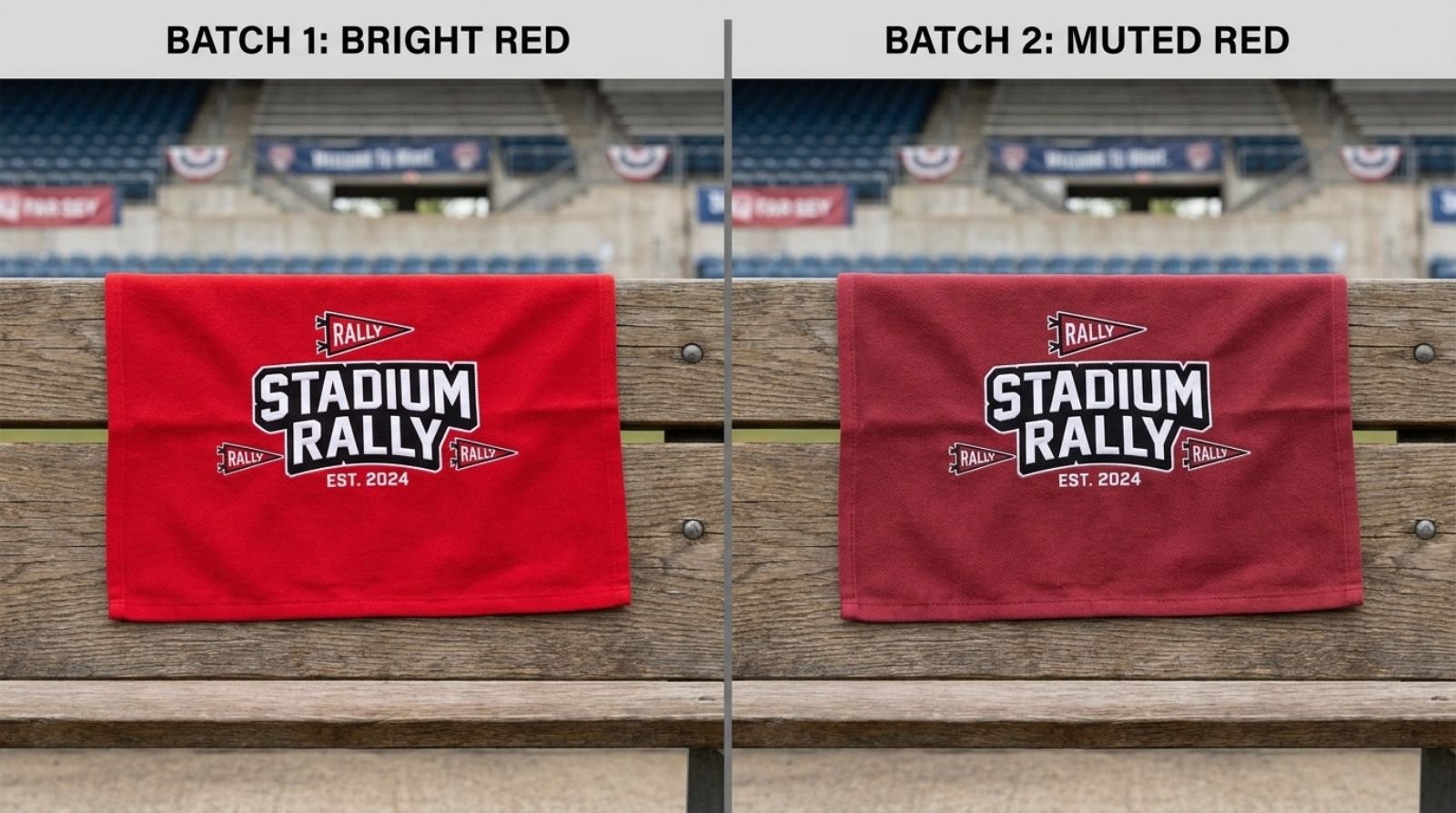
Your first run was 12,000 rally towels. Five months later you reorder 3,000 more so the team can restock the playoff shop — and when the cartons are opened side by side, the two runs are visibly different reds.
Nobody made a mistake. The second order was placed correctly, the artwork was identical, and the factory did exactly what was asked. The colors still do not match, and they never will — unless the first order was set up to make a match possible.
This is the reorder problem, and it is the single most common way a good supplier relationship goes bad. Here is why run two differs from run one, and the seven things you have to lock down before the first order ships.
Why Run Two Never Matches Run One
Custom merchandise is not a digital file. It is dyed, printed, knitted, and finished in batches, and every batch carries its own physical history.
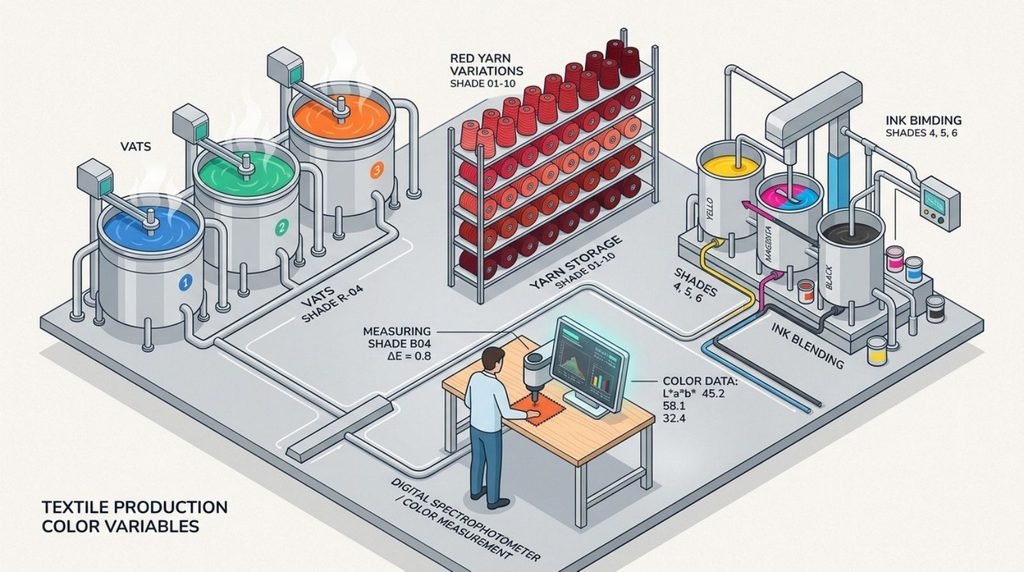
| Variable | What changes between runs |
|---|---|
| Dye lot | Fabric is dyed in vats. Each dye lot carries a slight color shift, and it is the number one cause of reorder mismatch. Your second run uses a different lot. |
| Yarn lot | For knitted goods — beanies, scarves, jacquard beer mittens — the yarn is dyed before it is knitted, so the mismatch is baked in before a single stitch. |
| Material supply | Mills change, discontinue lines, and adjust blends. “320 gsm cotton terry” from a different mill is a slightly different base white. |
| Ink batch | Screen-print ink is mixed by hand to a target color. A re-mix is a new color, even when the formula is written down. |
| Printing assets | Screens degrade and get remade. Digital printers get re-calibrated. Plates are replaced. Each of those resets the starting point. |
| Production line | The same factory running the same product on a different line can produce a measurable shift. A different factory will produce a bigger one. |
| Time itself | Textiles age. Whites yellow, dyes fade under UV, and the physical sample you approved eighteen months ago is no longer the color you signed. |
In practice, a reorder differs because three or four of these move at once, and each one adds a little distance to the last. No single cause needs to be dramatic for the final result to be obvious in a side-by-side comparison.
The Honest Truth About “Exact Match”
This is the part suppliers often avoid saying, so let’s say it plainly: across separate dye lots, a guaranteed exact color match is not physically achievable.
The color of a dyed textile depends on the fiber, the dye recipe, the water, the temperature curve, and the machine that ran it. Repeat that process four months later with a new lot of fabric and a new mix of ink, and the output will land close — but not identical.
What a factory can do is control the distance and prove it. That is where tolerance comes in.
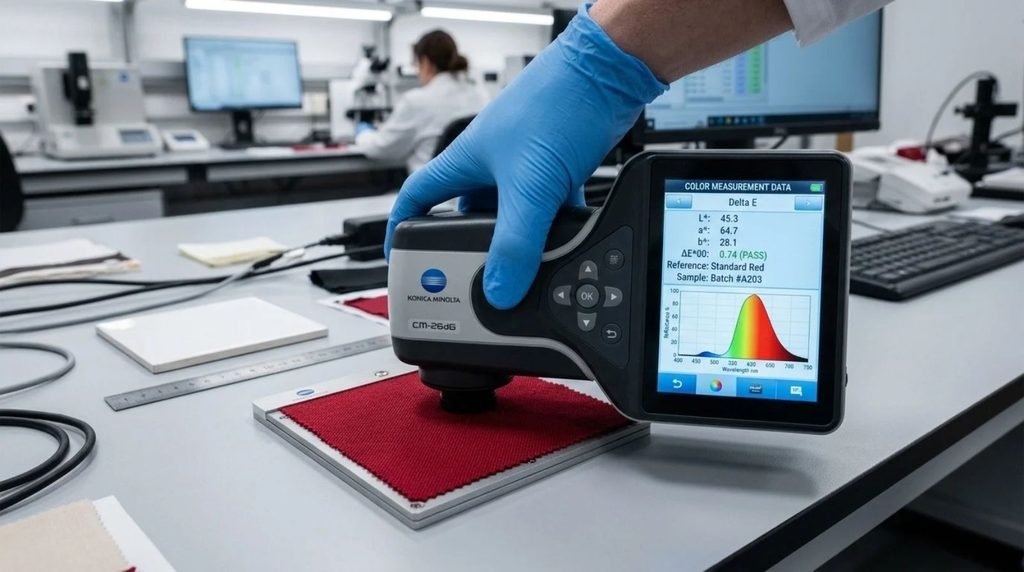
ΔE (Delta E) is the standard numeric measure of how far apart two colors are. It is measured with a spectrophotometer, not by eye. As a working guide:
| ΔE | What it looks like in practice |
|---|---|
| Under 1.0 | Most people cannot tell the difference |
| 1.0 – 2.0 | Perceptible only in a close side-by-side comparison |
| 2.0 – 3.5 | Noticeable, especially in large flat areas of color |
| Above 3.5 | Reads as a different color |
Most brand programs set a textile limit somewhere between ΔE 1.5 and 2.0. Sports merchandise programs with visible large color areas often work to the tighter end, because a stadium full of fans is a very large flat area.
Two practical notes that buyers usually learn late:
- Write the number into the PO, not the email thread. “Match the approved standard within ΔE 2.0, measured under D65 illumination” is a commitment. “Match the color please” is not.
- Watch for metamerism. Two fabrics can match under office light and mismatch under stadium floodlights or daylight. If your product is used outdoors, approve the standard under the lighting it will actually live in.
The Seven Things to Lock Before Run One Ships
Every one of these is decided on the first order and costs little to include. Leaving them out is what makes the reorder expensive.
- Reserve material from the same dye lot. Ask the factory to hold back enough fabric from the original lot to cover your realistic reorder. This is the single most effective fix, and the only one that can deliver a near-perfect match.
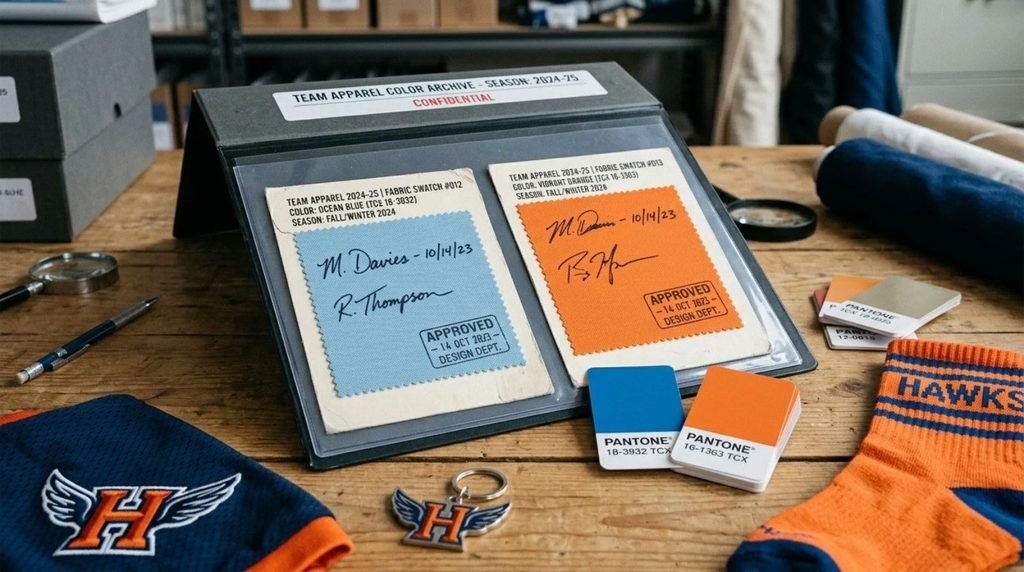
- Keep two signed physical standards. One stays at the factory, one stays with you, both stored away from light and heat. A digital file cannot be compared against fabric; a physical sample can.
- Retain the printing assets. Screens, plates, and cylinders should be held for an agreed period — typically six to twelve months. For digital printing, retain the file, the ink reference, and the printer profile.
- Commit to a single production site. A second factory for the reorder is a guarantee of a visible mismatch. This is the same failure mode we broke down in Two Suppliers, Double the Color Risk, just spread across time instead of across suppliers.
- Define the reorder window in the original PO. How long is the price held? How long is the color held? How long are the assets held? A reorder quoted twelve months later is a new project.
- Agree the remedy before production starts. If the reorder measures ΔE 3.2 against the standard, what happens? Rework, credit, or acceptance at a discount — decide while everyone is still friendly.
- Control the mixing after arrival. Date-code the cartons and ship the reorder separately. If both runs sit on the same warehouse shelf, someone will hand out mixed stock at the same event, and that is when a minor shift becomes a visible one.
The Products Where This Hurts Most
Reorder risk is not evenly distributed. It depends on how much flat color the customer sees, side by side.
| Product type | Reorder risk | Why |
|---|---|---|
| Solid-color cotton goods — tote bags, solid rally towels, aprons, blankets | Highest | Large flat color fields sit next to each other; small shifts are obvious |
| Knitted goods — beanies and scarves, jacquard mittens | High | Yarn dye lots, plus higher minimums and longer lead times to re-run |
| Full-bleed sublimated prints — flags, printed towels | Moderate | Busy artwork hides variation, but whites and skin tones still shift |
| Metallic, neon and specialty finishes | Highest of all | Flake and pigment behavior is rarely repeatable to a tight tolerance |
| Licensed team-color goods | Special case | The real risk is drifting away from the official team color, not just away from your own last run |
That last row deserves its own warning. A reorder of licensed merchandise has to be checked against the official color standard, not merely against the previous shipment. If run two matched run one but both had drifted from the licensed Pantone reference, you have a compliance problem rather than a warehouse problem.
What It Costs to Get This Right
Holding material is not free, and any supplier who tells you otherwise is not being straight with you.
Reserving fabric ties up cash and warehouse space, and you pay for the hold-back whether or not the reorder ever happens. So compare it against the alternative:
- Cost of holding: material for your expected reorder, carried for six months.
- Cost of not holding: a reorder that arrives a visible shade off — repriced as seconds, discounted, donated, or re-run at full cost plus air freight to hit the same date.
For most programs with a realistic chance of a reorder, the hold-back is the cheaper of the two. Where it genuinely is not — a one-time event, a product with no replenishment path — the right answer is to skip the hold-back and change your reorder plan instead.
That decision is also easier to get approved when the numbers sit on one page next to the timeline and the risk. Our one-page merch plan format has a line for exactly this.
Three Reorder Strategies — Pick One Before You Order
There is no single correct answer, but there is a correct answer for your program. Choose it before run one, not after run two arrives.
| Strategy | How it works | Best for | Trade-off |
|---|---|---|---|
| One and done | Order the full season quantity once. Never reorder. | Fixed events, licensed one-off campaigns, unknown demand | You carry inventory risk, and you may run short |
| Reorder-ready | Hold back material, assets, and a signed standard; keep the reorder window open | Playoff runs, hot sellers, retail replenishment, evergreen SKUs | You pay a small carrying cost for material you may not use |
| Planned discontinuity | Accept that run two will differ and design so it reads as intentional — new season mark, new colorway, “2027 edition” | Fan merchandise, seasonal programs, anything with a yearly refresh | The product line changes rather than continues |
The third option is the most under-used. If a second run is designed to look different — a new year mark, a new trim color, a blackout version — then a slight shade shift stops being a defect and becomes part of the design. Buyers who plan for this stop fighting physics and start using it.
Reorders Are Faster — With One Important Exception
A well-set-up reorder skips artwork approval, vector prep, and sampling, which is where a first order loses its first two weeks. With material held in stock and assets retained, a repeat run is typically the fastest order you will ever place with a factory.
The exception is timing, and it is a sharp one. Reorders cannot be squeezed into a factory shutdown or a peak-season backlog, no matter how simple the product. If the reorder has to land before a fixed date, the order book decides — not the product. That constraint is laid out in detail in Super Bowl LXI Meets Chinese New Year 2027, where a four-week shutdown removes the entire reorder option for February programs.
Seven Questions to Ask Before You Place Run One
- How much fabric would you need to hold back from this exact dye lot to cover a reorder of ______ units?
- How long can you hold it, and what does that cost?
- Can you retain the screens, plates, or digital profile, and for how long?
- What tolerance will you commit to on a repeat run — and how is it measured?
- Will both runs be produced at the same site, on the same line where possible?
- How long is the quoted price held for a reorder?
- If the reorder falls outside tolerance, what is the remedy?
If a supplier cannot answer these before the first order, they will not be able to answer them afterward either. It is also worth running the wider set of questions in our guide on what to ask before you order — the reorder items above sit alongside delivery, capacity, and QC.
The Bottom Line
A reorder that does not match is not bad luck. It is the predictable result of a first order that did not reserve material, retain assets, or define a tolerance — because nobody was thinking about run two while run one was still on the table.
The fix is cheap and it happens early: hold back the fabric, keep two signed standards, retain the print assets, agree on a ΔE limit, and write it all into the purchase order. Then a reorder is what it should be — the easiest order you place all year.
At J&F, we produce custom sports promotional products for teams, sponsors, agencies, and event organizers — rally flags, towels, bags, caps, knitwear, blankets, drinkware, and complete fan gift boxes. We have served teams across the NFL, MLB, NBA, and MLS since 2004, with audited factories, 25+ digital printing machines, and factory-direct air and sea freight.
If you are planning a first run that may need a second one, tell us at the quote stage. Send the product, the quantity, your expected reorder size, and the arrival date for each — we will hold the right material from the right lot, keep your assets on file, and tell you honestly how close a repeat run can match.