Your event date is locked, you have three quotes and two sample photos, and you are standing in a 15-minute budget meeting. Then someone asks the question you have been dreading: “Why this supplier — and what happens if the goods don’t arrive?”
Most promotional programs do not fail because the product was wrong. They fail in that meeting. The buyer brought a product; the approver wanted a plan.
This article gives you that plan on a single page, and shows how the same eight blocks carried a 140,000-piece rally flag order that had to ship in seven days — before a Super Bowl.
Why Good Programs Get Sent Back
If you have ever watched a solid idea get tabled “for more information,” it was almost certainly missing one of five answers. Approvers — a club’s merchandise director, a brand’s marketing lead, a finance manager — are not evaluating your product. They are evaluating their own exposure.
| What they are really asking | What they need to see |
|---|---|
| “What is this, in one sentence?” | A stated objective, not a product name |
| “What does it cost — really cost?” | Landed cost, not unit price |
| “When does it land, and what if it slips?” | An arrival date and a named fallback |
| “Why this supplier?” | Verifiable capacity and compliance, not a price |
| “What am I actually approving today?” | A specific decision and a decision deadline |
Every one of those is a one-line answer. The problem is that most proposals spread them across four slides and an email thread.
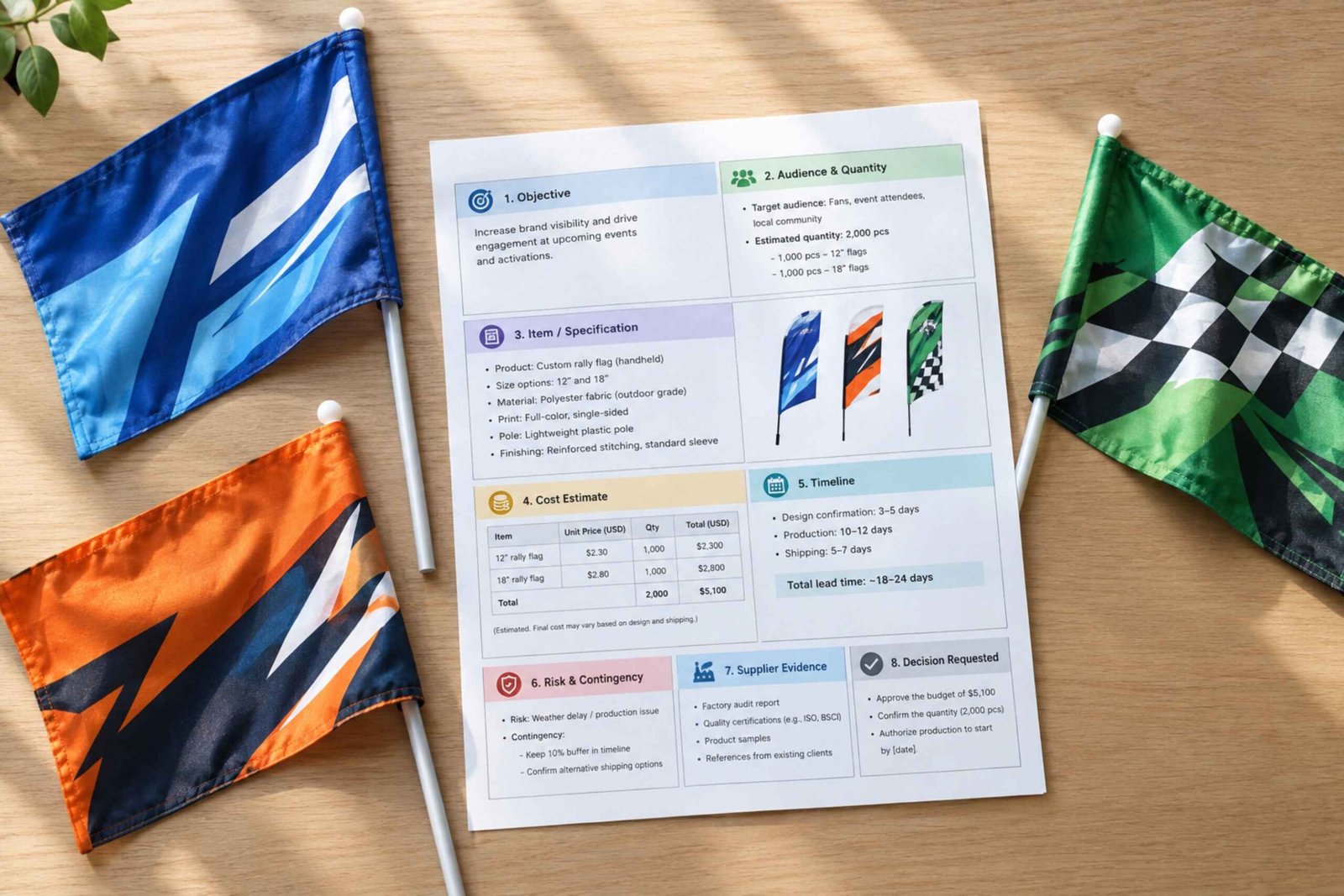
The One-Page Plan: Eight Blocks
Here is the whole format. One page, eight blocks, no narrative padding.
| # | Block | What goes in it |
|---|---|---|
| 1 | Objective | One sentence: what this program is supposed to achieve |
| 2 | Audience & quantity | Who receives it, how many, and where |
| 3 | Item & spec | Product, size, material, print method — one line per item |
| 4 | Cost | Unit cost, freight, landed cost per unit, total program cost |
| 5 | Timeline | Order date → artwork approval → production → ship → arrival |
| 6 | Risk & contingency | Two named risks, each with a specific fallback |
| 7 | Evidence | Why this supplier can do it: audits, capacity, comparable project |
| 8 | Decision requested | The exact approval needed, and by what date |
Block 8 is the one people forget, and it is the reason plans get deferred. “Please approve” is not a decision. “Approve the 40,000-unit rally towel program at $X landed, seafreight, artwork locked by October 3” is.
Filling It In: A Worked Example
Below is a filled-in version for a hypothetical playoff program. The numbers are illustrative — the structure is the point.
| Block | Filled in |
|---|---|
| Objective | Give every home playoff attendee a team-color rally towel to drive stadium-wide visuals for broadcast |
| Audience & quantity | 40,000 units, distributed at two home playoff dates; 20,000 per game |
| Item & spec | 16″ × 25″ rally towel, 100% cotton terry, 320 gsm, dye-sublimation print, two-sided |
| Cost | $2.15/unit + $0.28 freight = $2.43 landed; $97,200 total program cost |
| Timeline | Order Oct 2 → artwork approved Oct 6 → production 18 days → ship Nov 8 (sea) → arrive Dec 12 |
| Risk & contingency | Risk: production slip. Fallback: split shipment — 15,000 units by air to protect game one. Risk: color mismatch against stadium signage. Fallback: one physical color card approved by both parties before production |
| Evidence | Factory audited (Sedex, BSCI, SA8000), 25 digital printing machines on site, in-house QC with pre-shipment reports, prior 20,000+ towel programs delivered |
| Decision requested | Approve $97,200 landed, sea freight, with artwork lock by October 3 |
That table is the entire proposal. If your approver reads only the last row, they still know exactly what they are being asked to sign.
Block 5 Is Where Good Plans Are Won
The timeline block has one rule that separates professional buyers from everyone else: state the arrival date, not the event date.
“The game is January 12” tells your supplier nothing about your deadline. “The goods must be in our warehouse by January 5, and here is the receiving address and dock hours” tells them everything. Suppliers build production plans backward from arrival — and so should your one-pager.
If you want to pressure-test whether a supplier can actually protect that date, our guide on the 7 questions to ask before you order walks through the questions that expose a soft commitment.
The Block Everyone Skips: Evidence
Block 7 is where most plans are weakest, because “we have used them before and it went fine” is not evidence.
For any overseas custom program, three categories of proof are worth listing:
- Compliance. Social-compliance and quality audits — for our factories, Sedex PILLAR 4, BSCI, SA8000, and product testing through SGS for CPSIA. This is the part your approver’s legal or compliance team will ask about later.
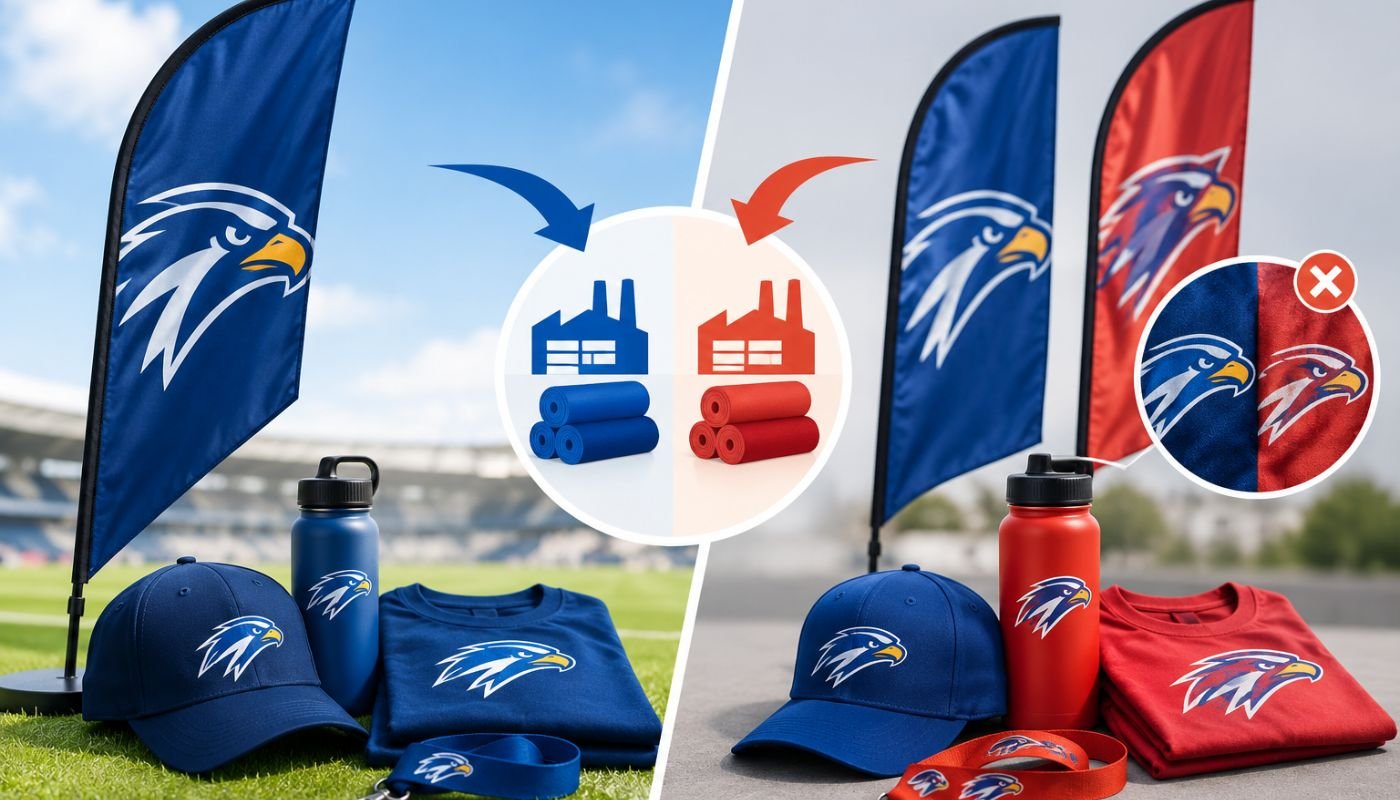
- Capacity. Not “we can do large orders,” but the actual production footprint: how many printing lines, whether materials are held in inventory, and whether the factory is single-site. Multi-site sourcing is where color consistency goes wrong — which is exactly the failure mode we broke down in Two Suppliers, Double the Color Risk.
- Comparable delivery. One named project of similar scale and complexity, with the arrival date it met.
Proof It Can Be Done: 140,000 Rally Flags in 7 Days
The strongest evidence block we can hand a buyer is not a certificate. It is a date.
Before a recent Super Bowl, J&F produced and shipped 140,000 rally flags in seven days — the kind of rush order that most factories would decline outright. It worked, and it is worth being precise about why, because none of it was luck:
- Artwork was approved before the clock started. The seven days were production days, not design days. Files arrived final, in vector format, with approved colors.
- Fabric was already in inventory. A material order alone can consume two to three weeks. Stocked raw material is what makes a seven-day promise physically possible.
- The work ran on parallel lines, at one site. More than 25 digital printing machines on the same floor means volume scales by lines, not by weeks.
- The order was never split. One factory, one material batch, one color standard — no reconciliation between two suppliers at the end.
- Freight was booked before production finished. Air capacity was reserved while the flags were still on the machines, so shipping started the day production ended.
There is an honest trade-off here, and it belongs in your plan rather than in a surprise invoice: rush production costs more and narrows your options. Formats simplify, color ranges tighten, packaging is stripped to the essentials, and air freight adds real cost per unit. Over the years we have learned that the buyers who get rush orders through are not the ones who negotiated hardest — they are the ones who made the early decisions that left room for a rush.
If you are building a program around a fixed game date, the season-wide deadlines are mapped in our 2026 NFL Season Promo Buyer’s Calendar, and the item-by-item recommendations are in the 2026 NFL Season Giveaway Planner.
What to Put in the Risk Block
A plan with no contingency tells your approver that you have not thought about failure. A plan with five contingencies tells them you have no confidence in the supplier. Two named risks is the right number.
The fallbacks that actually work in this industry:
- Split shipping. Air-freight the first 30–40% to protect the anchor date; send the balance by sea. One order, two lanes. This is also the standard fix when a playoff run is uncertain — see how to structure that in How to Plan a Stadium Giveaway When Your Event Date Is Fixed.
- Reduce the color count. Fewer colors and simpler artwork can cut production days without changing the item.
- Swap the format, keep the function. If knitted headwear will not make the date, a printed alternative often will — the fan experience survives, the deadline does not move.
- Pre-approve a neutral design. For anything tied to a playoff outcome, neutrally branded packaging and a generic “postseason” wordmark avoids a reprint after the bracket settles.
And one item that belongs in the plan before anything else: state your licensing position. If the artwork involves team or league marks, say whether you hold the rights or need a neutral alternative. A design that cannot legally be printed is the most expensive kind of delay, and it is discovered late when it is left out of the brief. Licensing rules are covered in depth in Can You Legally Print That Logo? — and if you are unsure, the safe path is a club-created or theme-color design, which is exactly what we recommend for sponsors without team rights.
Five Mistakes That Get a Plan Sent Back
- Unit price instead of landed cost. Your approver will find the freight line eventually, and it will cost you a second meeting.
- An event date with no arrival date. These are different dates, and the difference is measured in weeks.
- No supplier evidence. A price is not a capability.
- Hidden contingency. Saying “it will be fine” transfers all the risk to the person signing, and they know it.
- A vague ask. Without a specific decision and a decision deadline, the plan becomes an agenda item for the next meeting.
Reusing the Plan Across the Season
The template earns its value the second time you use it. Once the eight blocks exist, they become a reusable library:
- Swap block 3 to move from rally towels to custom flags and banners or a fan gift box, and the cost, timeline, and risk blocks only need updates rather than rebuilds.
- Swap block 2 for a different audience, and the same plan serves season-ticket member gifts — the structure we outlined in creating custom season ticket member gifts.
- Keep block 7 current. A living evidence page — audits, capacity, and the last comparable delivery — is what makes the next approval faster than this one.
For buyers running several programs at once, reusable stadium and event items and promotional towels are usually the categories that repeat every season, which makes them the best candidates for a standard plan.
The Bottom Line
Approval meetings do not reward enthusiasm. They reward clarity: what it is, what it costs, when it lands, what happens if it slips, and why this supplier can be trusted to deliver.
Eight blocks on one page answers all five questions — and if you need to prove the fifth one, a project that shipped 140,000 rally flags in seven days is a better argument than any slide.
At J&F, we produce custom sports promotional products for teams, sponsors, agencies, and event organizers — rally flags, towels, bags, caps, beanies, blankets, drinkware, and complete fan gift boxes. We have served teams across the NFL, MLB, NBA, and MLS since 2004 with audited factories, 25+ digital printing machines, and factory-direct air and sea freight.
If you are preparing a program for approval, send us your target arrival date, quantity, artwork, and delivery address. We will return the honest version of the timeline — including what your budget can realistically buy, and where a rush order is the only option left.