Somewhere in your Q4 plan there is a line item that looks like smart risk management: 30,000 rally towels, split 60/40 between two factories. You did it because a supplier missed a date last year, and you promised yourself it would never happen again.
We are a factory, so by suggesting you keep the whole item in one place, we are arguing for our own order book. Weigh everything below with that in mind. But the reason split-sourcing a single SKU usually creates a worse problem than the one it solves has nothing to do with loyalty, and everything to do with how color is actually made.
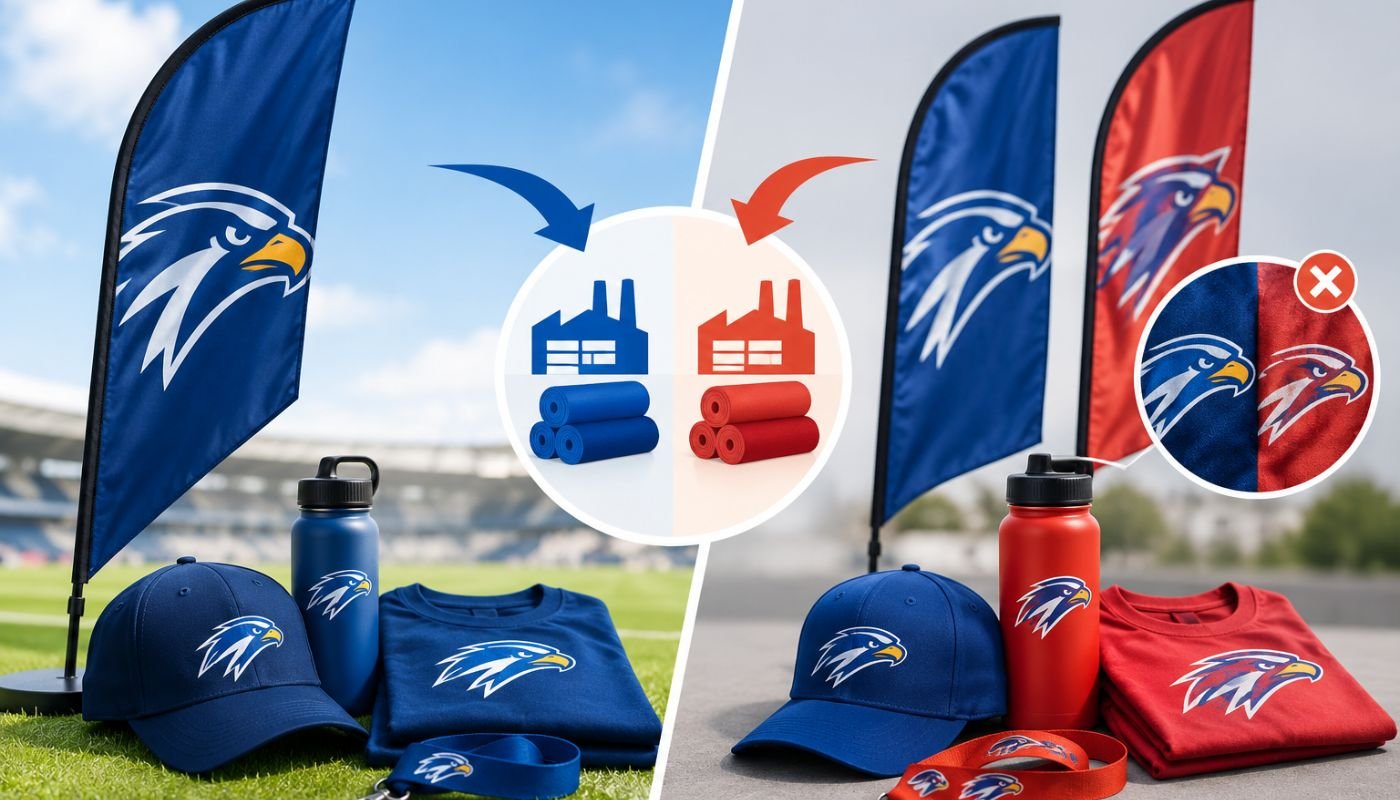
Color is not a property of your order. It is a property of a production line.
Most buyers carry an implicit assumption: “team red” is a fixed value, and any competent factory should hit it. In dye-sublimation on polyester, it isn’t a value. It is the output of a stack of variables:
- The base fabric’s own shade, which shifts by dye lot even within a single mill
- The ink or dye set — the brand, its age, and how the press profile was built around it
- Transfer temperature, pressure, and dwell time on that specific machine
- How the roll was handled, and how much the fabric stretched while printing
- Finishing and surface texture, which change how the material diffuses light
Now multiply that stack by two. Each factory can be individually excellent and collectively wrong: two batches that are each “correct” and visibly different the moment they sit next to each other. Both inspection reports can be clean. The mismatch only appears when the two batches meet — in the stands, in a broadcast shot, in the group photo your client posts the next morning.
That is the failure no QC report is designed to catch.
| Risk source | How it shows up on site | How you control it |
|---|---|---|
| Fabric dye lot | Two batches read as two shades under stadium lights | Whole order cut from one lot; lot number confirmed in writing |
| Ink set and press profile | One batch slightly cooler or warmer | One print line runs the entire quantity |
| Machine calibration | Batch B drifts after a press restart | First article off the actual run, photographed |
| Operator judgment | “Close enough” passes at one plant, fails at the other | Physical master swatch; both sides hold the same piece |
| Finishing and packing | Color looks different because the pile lies differently | Compare finished goods side by side, not printed panels |
The places where a mismatch does the most damage
Rank these by how much they cost you, and the logic of “at least I got the units” falls apart fast:
- In the stands, during play. Thousands of fans hold the item up at once. A shade difference doesn’t read as a shade difference; it reads as a stripe across a section.
- In a broadcast frame. One wide shot, and two adjacent sections look like two different products. The club’s social team will post that image.
- On a sponsor’s mark. Sponsor brand standards are the strictest document in the room, and sponsors are the party most willing to escalate.
- Months later, on the client’s shelf. A leftover box from batch A is opened beside batch B, and now the mismatch has a paper trail.
Notice that three of the four happen after the goods were accepted. Nothing was defective. Nothing failed inspection. The order still became a problem.
Where split-sourcing genuinely pays
We are not arguing that you should never split an order. It is the wrong tool for one job and the right tool for several others.
It is sound to split:
- Across product categories. Rally towels from one plant, can koozies or clear PVC totes from another. Different substrate, different process, and no one ever holds them side by side against a color standard.
- Across entirely separate programs. Two different clients, two different events, two different reference swatches. No shared standard means no shared failure.
- Where capability, not capacity, forces it. A technique you cannot source in one place is a legitimate reason to separate — as long as the two outputs are never compared.
The distinction to hold onto: split across categories; never split across units of the same item.
What actually protects the date
If your real concern is the event date, spend your risk budget there instead. These are the levers that move it:
- Lock the slot, not the lead time. The useful question is not “what is your lead time,” it is “which week does my order run, and what else is on that line?” A 12-day item in June becomes a 25-day item in October when the plant is full.
- Reserve raw material from a single lot. Ask for the entire quantity to come from one fabric lot, and get the lot number in the order confirmation, not in a verbal assurance.
- Approve a physical master swatch, not a PDF. A signed production swatch that both sides physically hold is the only reliable color reference. Files travel perfectly and prove nothing about fabric.
- Put the inspection method in writing. AQL level, defect definitions, and the color check itself: defined light source, side-by-side comparison against the master swatch, and a tolerance figure where spectrophotometer readings are available.
- Ask for first-article evidence, not a sample. A photo of the first unit off the actual run, plus a batch photo of finished units, tells you more than a hand-made sample that received extra care.
- Settle the white question before artwork locks. In sublimation, white is not printed — it is the base fabric showing through. If your design depends on white, the fabric choice is a color decision, not a spec detail.
- Define “acceptable” with your client in advance. Write down what the client considers a match, in the venue’s own lighting, before production starts. That single sentence prevents the worst version of this conversation.
- Hold the last 10% as capacity, not inventory. If a reorder is possible, secure the slot and the material. Buying 10% extra to store is a 10% margin hit that usually ends in a dumpster.
If you are going to split it anyway
Sometimes a date leaves you no choice. If you must split the same SKU, do it with the reference tightly controlled:
- Send both factories the same physical master swatch — the same piece of fabric, not two prints of the same file.
- Run both first articles before either production run starts, and compare them side by side in the same light.
- Designate one factory as the color master. The other matches to it. Someone has to hold the standard.
- Segregate batches by date or by venue section, so mismatched units never appear in the same photograph.
- Tell your client about the tradeoff before production, not after. Buyers who name the risk in advance keep the account. Buyers who explain it afterward usually do not.
The real cost of getting this wrong
A reprint is inconvenient. What it actually costs is the client’s confidence, plus the week you had not planned for — and it lands against someone else’s event date, which is the hardest kind of shortage to recover from.
The underlying point is simple: color consistency is a manufacturing capability, not a purchase specification. It is decided by who controls the fabric lot, the ink set, the press, and the operator on the floor. The moment that control is divided between two facilities, consistency stops being a production problem and becomes a negotiation you will have with your client.
One line worth taking to your client: “If you want consistent color, order the whole item from one line, from one lot — and spend your risk budget on locking the date instead of splitting it.”
If you are holding a fixed event date and weighing whether to split an order, send us your item mix and quantities. We will tell you where the real risk sits — including the cases where the right answer is to split across categories, and the cases where it is not.
ASK FOR A QUICK QUOTE — kiteflag@kiteflag.com