In the competitive landscape of professional sports merchandising, the difference between a “disposable giveaway” and a “premium fan keepsake” lies in the details that are never seen.
For B2B procurement officers, global sponsors, and professional sports franchises, the pillow is a high-visibility touchpoint. However, the true value of this product is dictated by what is inside.
At J&F Promotions, we approach pillow manufacturing with the same precision as high-performance athletic gear.
This technical guide explores the engineering, chemistry, and sustainability of pillow fillings—and why these factors are critical for your brand’s ROI, logistical efficiency, and global compliance.
I. The Denier Dilemma: Engineering the Perfect “Hand-Feel”
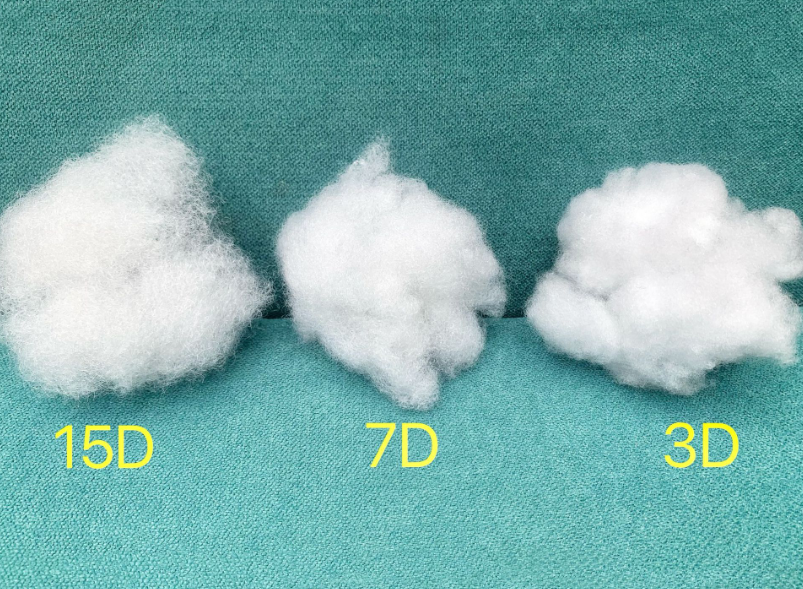
In the textile world, the term “softness” is often used loosely. To a manufacturer, softness is a measurable result of fiber thickness, known as Denier (D). One denier is defined as the weight in grams of 9,000 meters of a single fiber.
The 7D vs. 15D Hybrid Strategy
Most budget-grade pillows use a single type of recycled fiber, often resulting in a product that feels either too “mushy” or too “stiff.” At J&F Promotions, we utilize a proprietary blend of 7D and 15D Polyester Virgin Fibers.
- 7D (Fine Micro-Fiber): These fibers are ultra-fine, mimicking the luxurious touch of natural down. They provide the immediate “soft-touch” that fans experience when they first handle the product.
- 15D (Hollow Conjugated Fiber): These are thicker fibers with a hollow center. Like a structural beam, they provide the “loft” and spring-back capability.
By blending these in a specific ratio, we create a Hybrid Matrix. The 15D fibers act as a structural skeleton that prevents the pillow from flattening under pressure, while the 7D fibers fill the gaps to provide a smooth, premium surface.
For a B2B buyer, this means the pillow maintains its “showroom look” far longer than standard retail offerings.
II. The Chemistry of Consistency: Organic Silicone Treatment
A common failure in mass-produced pillows is “clumping.” After a few weeks of use, the internal fibers begin to entangle, leading to a lumpy, distorted appearance. This is not just an aesthetic issue; it is a brand failure.
The Friction-Reduction Mechanism
To prevent this, J&F Promotions utilizes Inert Organic Silicone (Siliconized) Treatment. This process coats every individual strand of fiber with a microscopic, friction-reducing layer.
- Fiber Fluidity: Because the fibers can easily slide past one another, the filling behaves like a fluid. When a fan leans against the pillow, the filling redistributes evenly. When they stand up, the fibers slide back into their original position.
- Anti-Moisture Properties: Silicone is naturally hydrophobic. In humid environments—such as shipping containers or outdoor stadium seating—this prevents the filling from absorbing moisture, which is the primary cause of odor and bacterial growth in textiles.
Global Compliance and Safety
For our partners in North America and Europe, chemical safety is a top priority. J&F Promotions ensures that all silicone treatments are PFAS-free and fully compliant with REACH (Registration, Evaluation, Authorisation, and Restriction of Chemicals). Our fillings are certified to OEKO-TEX® Standard 100, ensuring that even the most sensitive users are safe from harmful residues.
III. The Sustainability Frontier: Bio-Based “Corn Fiber” Fillings
The modern sports industry is undergoing a massive shift toward ESG (Environmental, Social, and Governance) excellence. Top-tier clubs in the NFL, NBA, and European Football leagues are now prioritizing “Green Procurement.”
The Innovation of DuPont™ Sorona®
J&F Promotions is a pioneer in integrating Bio-based fibers into sports merchandise. Often referred to as “Corn Fiber,” these materials are derived from the fermentation of plant-based sugars.
- Reduced Carbon Footprint: The production of bio-based fiber consumes 30% less energy and releases 63% fewer greenhouse gas emissions compared to traditional nylon or polyester production.
- Molecular Spring Effect: Unlike traditional petroleum-based fibers, Sorona® has a unique “Z-shaped” molecular structure. This provides a permanent, mechanical stretch. While traditional fibers lose their “bounce” over time due to material fatigue, bio-based fibers retain their loft for years.
- The Marketing Edge: For a sponsor, being able to put a “Made with 30% Plant-Based Materials” tag on a pillow is a powerful marketing tool that resonates with the environmentally-conscious Gen Z and Millennial fanbases.
IV. The Logistics of Volume: Compression and Memory
For the B2B buyer, the cost of the product is only half the equation; the other half is the cost of getting it to the warehouse. Pillows are notoriously “expensive air.”
High-Ratio Vacuum Engineering
J&F Promotions has perfected the High-Ratio Vacuum Compression process. By using high-grade virgin fibers rather than “regenerated” or “recycled” scrap cotton, our pillows can withstand extreme pressure without damaging the fiber’s integrity.
- Shipping Efficiency: We can compress our pillows to 40% of their original size. For a 40HQ container, this effectively doubles the unit capacity, cutting your per-unit shipping cost in half.
- The “Instant Loft” Test: The true test of a quality supplier is what happens when the vacuum seal is broken. Low-quality pillows stay flat or require “massaging” to regain shape. J&F pillows feature Zero-Lag Recovery—they snap back to 95% of their original volume within 10 seconds. This is critical for event planners who need to distribute thousands of items immediately upon arrival.
V. Avoiding the “Recycled Cotton” Trap
In an effort to win on price, many manufacturers use “Regenerated Polyester” or “Off-cut Scraps.” While this sounds “recycled,” it often involves shredding old garments or textile waste.
The Risks of Sub-standard Filling:
- Inconsistent Density: Scraps are irregular, leading to “soft spots” in the pillow.
- Hygiene Issues: Recycled scraps can contain trace amounts of dyes, oils, or dust from the previous lifecycle, leading to a “musty” smell.
- Dust Mite Vulnerability: Regenerated cotton is more prone to harboring allergens than virgin synthetic fibers.
At J&F Promotions, we maintain a strict Virgin Fiber Policy unless a client specifically requests a certified GRS (Global Recycled Standard) post-consumer plastic filling. This ensures that every pillow delivered is clean, consistent, and durable.
VI. Case Study: 140,000 Units in 7 Days
To illustrate the importance of filling quality, consider a high-volume stadium activation. For a major NFL event, J&F Promotions was tasked with producing and delivering over 100,000 units within a rigorous timeline.
The success of this project relied on filling consistency. Using automated high-pressure blowing machines, we ensured that every single unit had a variance of less than ±5 grams. This precision meant that when 70,000 fans held up their pillows for a stadium-wide brand moment, every pillow looked identical—no sagging, no wrinkles, just a perfect canvas for the team’s logo.
Conclusion: Making the Invisible, Visible
In the B2B world, quality is not a luxury; it is a risk-mitigation strategy. Choosing a pillow with superior filling engineering means fewer customer complaints, lower shipping costs, and a brand image that remains “plump” long after the final whistle has blown.
At J&F Promotions, we don’t just sell pillows. We sell textile engineering that stands the test of time, transit, and the most passionate fans in the world.