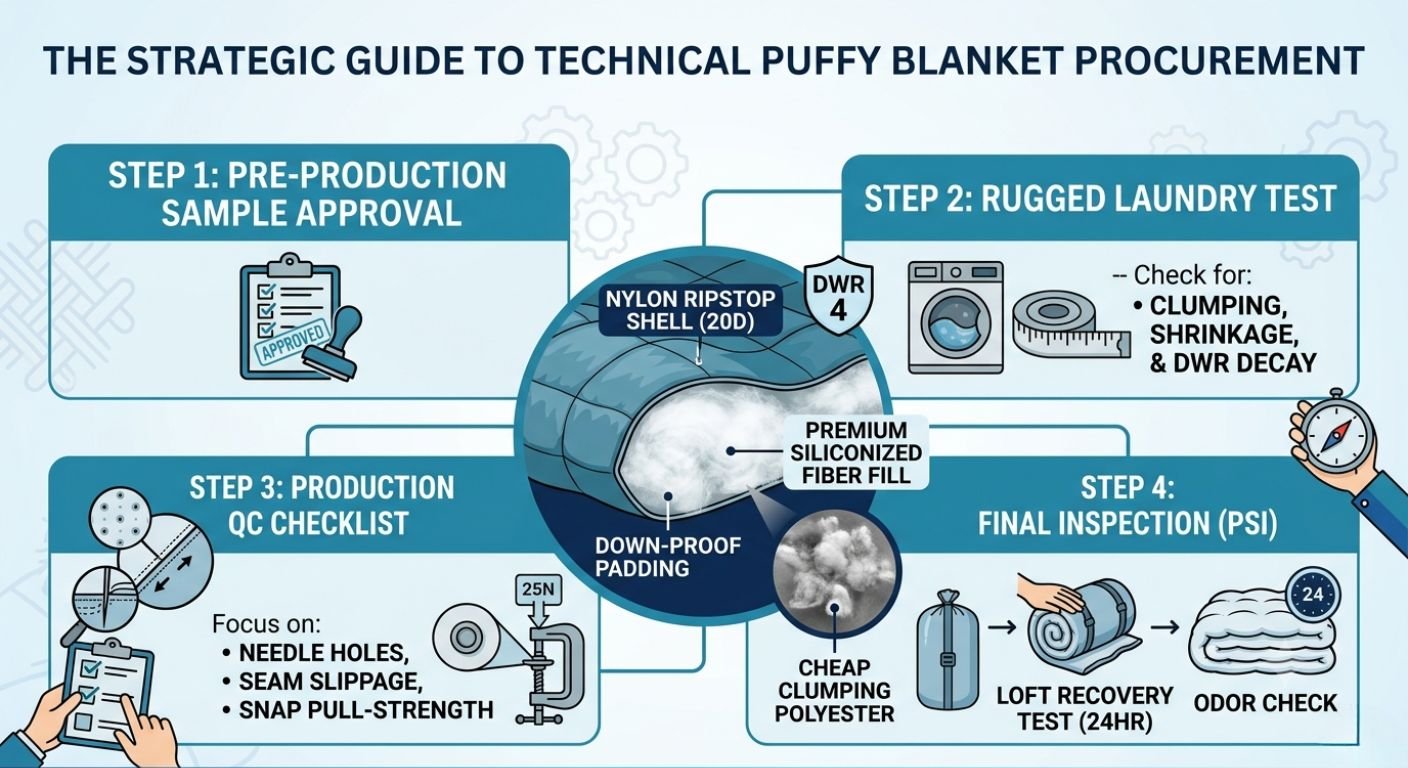
In the outdoor gear and corporate gifting markets, the Puffy Blanket has transitioned from a trendy novelty to a core product category. Its construction seems deceptively simple: shell fabric, insulation, and quilting.
However, beneath this simple anatomy lies a minefield of technical challenges.
For procurement professionals, a lack of strict material specifications and quality control (QC) metrics can lead to deflated loft, severe down-leakage, failed water repellency, and high post-purchase return rates.
This comprehensive guide breaks down the critical hidden risks, exact material specifications, and actionable inspection frameworks required to source high-performance puffy blankets at scale.
1. Fabric Specifications: Overcoming the “Slippery & Static” Dilemma
The shell and lining fabrics dictate the blanket’s hand-feel, durability, and perceived value. Many suppliers quote low prices by substituting technical fabrics with generic garment-grade materials.
The Material Trap: Polyester Taffeta vs. Nylon Ripstop
Many factory-standard quotes offer Polyester Taffeta. While cost-effective, polyester is inherently stiffer, highly prone to static electricity, and creates an aggressively “slippery” surface that easily slides off a user’s body or camp cot.
- The Procurement Standard: Specify 20D or 30D Nylon Ripstop (6.6 Nylon preferred) for both the shell and lining. Nylon offers superior tensile strength, a significantly softer, more silk-like hand-feel, and better drape. The “Ripstop” grid (cross-hatch pattern) prevents punctures or small tears from expanding under outdoor conditions.
Chemical Finishes & Performance Treatments
A puffy blanket must withstand dew, light rain, and spills. Never accept a verbal promise of “waterproof fabric.”
- DWR (Durable Water Repellent): Mandate a C0 (Fluorine-Free) DWR finish. This aligns with modern environmental regulations (especially in the US and EU) and prevents import customs friction. Specify a performance metric: Initial spray rating of Grade 4; retaining Grade 3 after 10-15 home launderings.
- Anti-Static Treatment: Nylon and polyester rub against insulation to generate friction. Ensure the fabric specification sheet explicitly includes an Anti-Static Finish. Without this, the blanket will attract pet hair, dust, and give users static shocks in dry, cold environments.
2. Insulation Dynamics: Combating Clumping and Odor
The insulation dictates the blanket’s “loft” (fluffiness), packability, and thermal efficiency. This is the easiest area for factories to cut corners without immediate visual detection.
Option A: Synthetic Insulation (The High-Volume/Easy-Care Route)
If you are ordering synthetic blankets, the biggest failure point is clumping and flattening after a single wash cycle due to the use of cheap, short-staple bonded padding.
| Insulation Type | Procurement Action & Specifications |
| Standard/Low-Cost (Avoid) | Resin-bonded spray cotton or generic polyester padding. |
| Premium Synthetic (Recommended) | Specify 3D/7D Siliconized Hollow Fiber or branded fills (e.g., 3M™ Thinsulate™, PrimaLoft® Eco). |
| Weight Specification | Standard indoor/outdoor balance requires 150 GSM to 200 GSM (Grams per Square Meter). |
Procurement Note: Ensure your purchase contract strictly states: “100% Virgin Virgin Polyester Fill. Zero recycled post-industrial scrap or second-grade blended fibers allowed unless specified as certified GRS (Global Recycled Standard) material.” Siliconization of the fiber is critical—it allows the fibers to slide past each other rather than locking together and clumping during washing.
Option B: Down Fill (The Premium/High-End Route)
If sourcing white duck down or goose down for a premium product line, you face two massive risks: Down leakage (running down) and microbial odor.
- Down Leakage Prevention: The shell fabric must have an internal Cire/Down-proof Coating (a heat and pressure calendering process that seals the gaps between woven threads). Furthermore, the sewing factory must use size 70/10 or smaller down-proof needles and textured polyester threads which expand when wet to seal the needle punctures.
- The Odor and Compliance Trap: Duck down processed with insufficient washing will develop a pungent, gamey animal odor when exposed to humidity or packed tightly in a shipping container.
- The Procurement Standard: Mandate a Turbidity (Cleanliness) rating of 1000mm+ and an Oxygen Number of less than 4.8mg/100g.
- Certification: Require a Responsible Down Standard (RDS) certificate for every batch to ensure ethical sourcing and smooth customs clearance.
3. Quilting & Stitching Engineering: Eliminating “Cold Spots” and Thread Breakage
The quilted patterns (wave, geometric, or mountain lines) are not just aesthetic; they stabilize the insulation. Poor stitching execution ruins the utility of the product.
Thread Tension & Stitch Density
Automated multi-needle quilting machines move at high speeds. If the machine tension is incorrect, the threads will fail under tension when a user pulls or shakes the blanket.
- Stitch Density: Specify 10 to 12 stitches per 3 cm. Too loose causes snagging; too tight punctures and weakens the lightweight shell fabric.
- Lockstitching: Ensure the contract specifies lockstitching with automatic backstitching at all line intersections. If a thread breaks in a cheap chain-stitch setup, the entire quilting line will unwrap like a zipper.
Managing the “Cold Spot” (Thermal Bridging) Effect
Intricate, hyper-dense quilting patterns look great in photos but create hundreds of compressed stitch lines where the insulation thickness drops to zero. This creates “cold spots” where cold air bypasses the insulation.
- The Procurement Standard: Keep quilting baffle widths or grid sizes between 15 cm and 25 cm. This provides the optimal balance between preventing insulation migration and maximizing loft thickness.
4. Hardware, Trims, and Packing: The Final 10%
A premium blanket can be completely ruined by a $0.05 plastic snap or a poorly engineered stuff sack.
Cape Clips (The Corner Snaps)
Most puffy blankets feature three or four snaps along the edges, allowing users to clip the blanket around their shoulders like a cape.
- The Engineering Trap: Lightweight 20D nylon cannot handle the mechanical stress of a snap being repeatedly ripped open. The fabric surrounding the snap will tear within weeks.
- The Procurement Standard: The factory must install an internal Reinforcement Patch (usually a durable polyester webbing or TPU tape backing) behind the fabric at every single snap location before riveting. Specify premium hardware brands like KAM® Snaps to prevent plastic brittleness in freezing outdoor temperatures.
Stuff Sack Volumetric Calculations
Factories often optimize stuff sack patterns to minimize fabric waste and shipping volumes, making the bag a tight, perfect fit for a machine-rolled blanket fresh off the line. However, a consumer out in the field cannot replicate machine-rolling.
- The Procurement Standard: Explicitly mandate that the stuff sack volume must be 15% to 20% larger than the absolute minimum compressed volume of the blanket.
- Design Upgrade: Consider switching from a traditional top-cinch drawstring bag to a Roll-top/Dry-bag style compression sack. It is significantly easier for the consumer to pack, handles volumetric variances seamlessly, and elevates the perceived retail value of the product.
5. Quality Assurance (QA) & AQL Inspection Framework
To protect your investment, integrate the following test protocols into your Golden Sample (Pre-Production Sample) approval process and your final Pre-Shipment Inspection (PSI) checklist under AQL 2.5 / 4.0 standards.
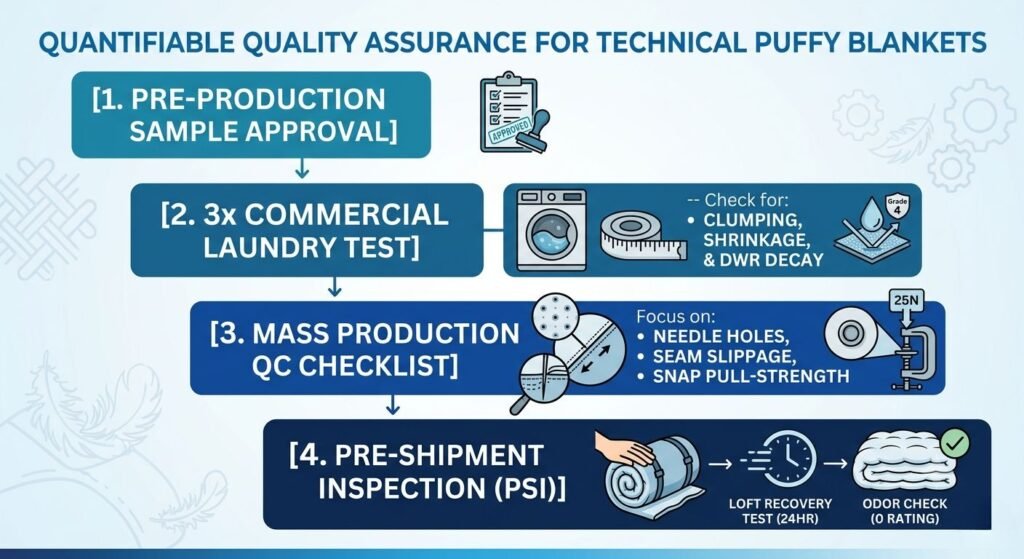
[Pre-Production Sample Approval]
[3x Commercial Laundry Test] ──► Check for clumping, shrinkage, & DWR decay
[Mass Production QC Checklist] ──► Focus on: Needle holes, seam slippage, snap pull-strength
[Pre-Shipment Inspection (PSI)] ──► 24-Hour Loft Recovery Test & Odor Check
Essential Quality Control Tests
- The 3-Cycle Commercial Laundering Test (Pre-Production Phase):Take three samples from the trial run. Wash them in a standard commercial washing machine at 40°C, followed by a tumble dry on low heat.
- Pass Criteria: Zero shifting or clumping of synthetic fill; no quilting thread breakage; less than 3% dimensional shrinkage; DWR still exhibits distinct water beading (no immediate soaking).
- The Snap Pull-Strength Test:Use a push-pull gauge on the cape clips.
- Pass Criteria: The snaps must withstand a minimum pulling force of 25 Newtons (N) without tearing away from the nylon fabric fabric or cracking.
- The 24-Hour Volumetric Loft Recovery Test:Keep three finished goods compressed tightly inside their stuff sacks for 72 hours. Unpack them and lay them flat.
- Pass Criteria: The blanket must regain at least 90% of its target loft height within 30 minutes of decompression, and 100% within 24 hours. If it remains flat or heavily creased, the factory has used low-grade, highly-diluted short-staple recycled insulation.
Conclusion & Sourcing Checklist
When drafting your Request for Quotation (RFQ) or tech pack, do not let the supplier fill in the blanks. Use this exact specification template to lock down your pricing and ensure quality parity among competing bids:
- Shell/Lining: 20D/380T Nylon Ripstop, Anti-Static Finished
- Water Repellency: C0 Eco-DWR (Grade 4 Initial / Grade 3 after 10 washes)
- Insulation: 100% Virgin 3D Siliconized Hollow Fiber, 150 GSM (or RDS Down, Cleanliness 1000mm+)
- Quilting: Lockstitch, 11 stitches per 3 cm, baffle spacing 20 cm
- Hardware: KAM Brand resin snaps with internal reinforced backing patches
- Packaging: Roll-top compression sack (+15% volume allowance over minimum compressed size)
By establishing these technical boundaries early, you shift the conversation with overseas manufacturers from subjective arguments over “hand-feel” to objective, contractually binding performance metrics.