Printing on clear soft PVC (Polyvinyl Chloride) sheets is notoriously tricky.
While it is a highly versatile material used in everything from modern lifestyle packaging and stationery to premium promotional banners, its chemical and physical properties present unique bottlenecks on the production floor.
If you have ever faced issues with ink peeling off, colors looking washed out, or sheets sticking together due to stubborn static, you are not alone.
Here is a technical breakdown of why clear soft PVC is so challenging to print on, and the industry-proven solutions—including the classic “paper-interleaving” method—to overcome them.
The Core Challenges of Printing on Soft PVC
1. Low Surface Energy (Ink Flaking)
Soft PVC has a naturally smooth, non-polar surface. Standard inks cannot bite into the material, acting like water on a glass window. Without proper treatment, the ink will easily flake, scratch, or peel off entirely when tested with standard adhesive tape.
2. Plasticizer Migration (“Oiling Out”)
To make PVC “soft” and flexible, manufacturers add a high percentage of chemical plasticizers. Over time, or when exposed to heat, these plasticizers migrate to the surface, creating a microscopic, oily film.
This film repels ink, causing printing defects like pinholes, ink crawling, or a sticky, uncured finish days after production.
3. High Elasticity & Thermal Distortion
Soft PVC stretches easily under tension and distorts at relatively low temperatures. High-speed web tension can cause registration errors (colors not aligning), while the heat generated by traditional UV curing lamps can warp, curl, or shrink the sheets.
4. Severe Static & Blockage
As an excellent electrical insulator, PVC generates massive amounts of static electricity during handling.
This static attracts airborne dust—causing white spots on clear prints—and causes the sheets to stick together tightly (blocking), leading to ink set-off or smudging during stacking.
The Solutions: A Master Setup
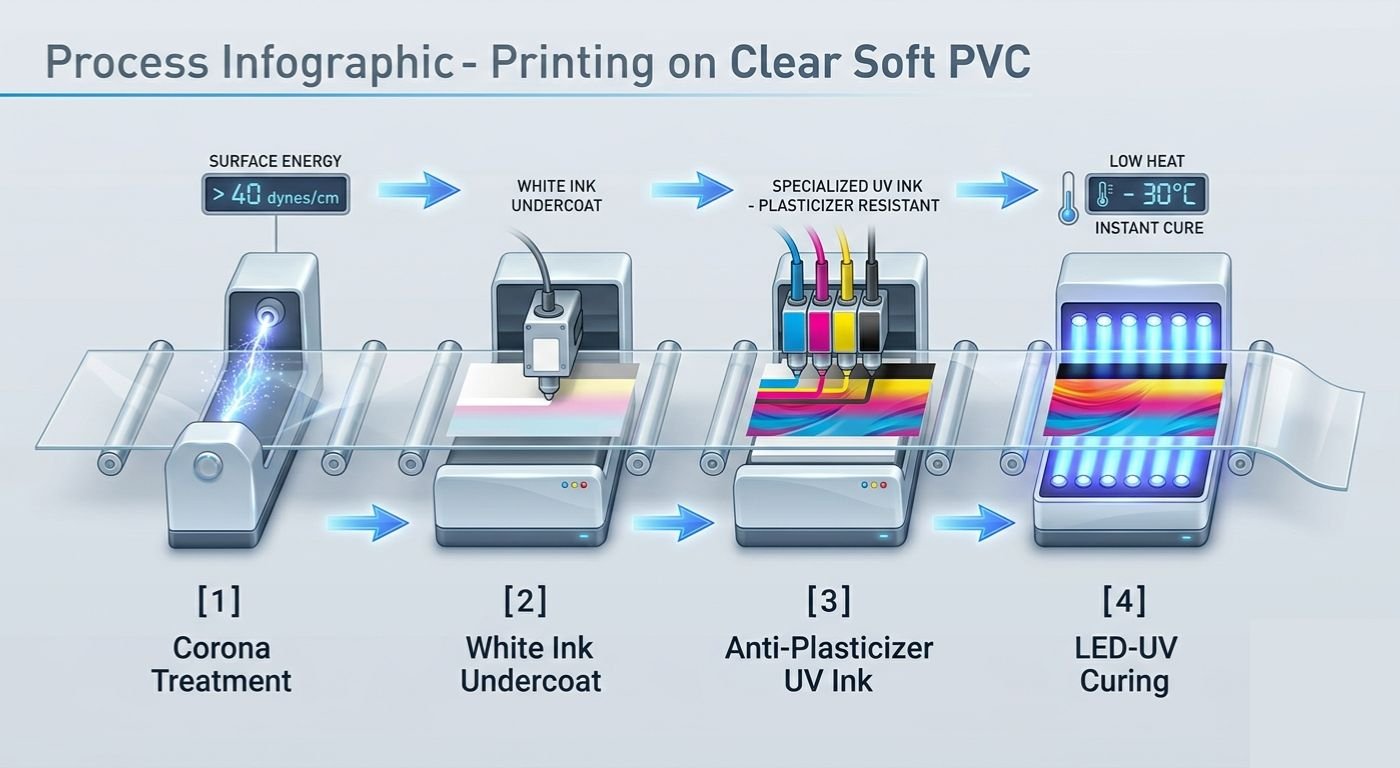
To achieve a flawless, high-saturation print on clear PVC, professional printers rely on a specific combination of pretreatments and advanced curing technologies.
![[Corona Treatment] ➔ [White Ink Undercoat] ➔ [Anti-Plasticizer UV Ink] ➔ [LED-UV Curing]](https://kiteflag.com/wp-content/uploads/2026/06/process-infographic--1024x562.jpg)
- Corona Treatment: Raises the surface energy to at least $38\text{–}40\text{ dynes/cm}$ to ensure robust ink adhesion.
- LED-UV Curing: Replaces traditional hot mercury lamps with “cold” LED-UV light to eliminate heat-induced warping.
- White Ink Undercoating: Because the substrate is perfectly transparent, a high-opacity white ink must be printed underneath the colored design to act as a barrier, ensuring vibrant, true-to-life colors.
Deep Dive: Solving Static and Smudging with “Paper Interleaving”
One of the most practical, low-cost, yet highly effective methods used in sheet-fed printing and finishing is Paper Interleaving (often referred to in the workshop as “inserting or lining paper”).
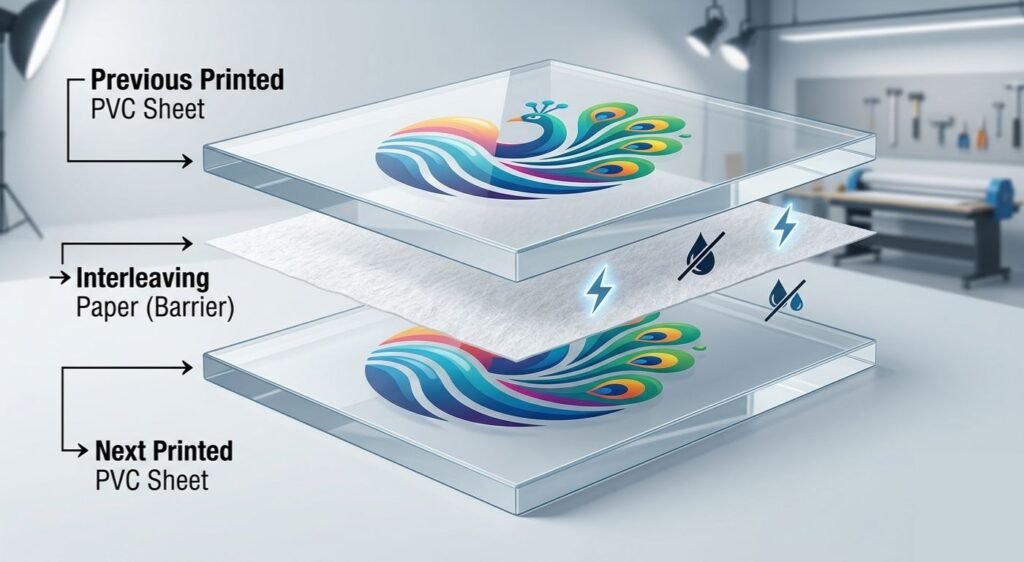
What is Paper Interleaving? > It is the process of placing a thin, specialized sheet of paper between each printed PVC sheet during stacking or rewinding.
How Paper Tames the PVC Beast:
- Static Dissipation: By placing paper between the plastic sheets, you eliminate the friction of plastic-on-plastic rubbing. The paper acts as a dielectric barrier, dramatically reducing static build-up during stacking and unstacking.
- Preventing Ink Set-Off (Smudging): Freshly cured UV inks or solvent inks need time to stabilize. Stacking heavy sheets creates pressure. The interleaving paper acts as a physical shield, preventing the wet or warm ink from transferring onto the backside of the sheet above it.
- Absorbing Excess Plasticizers: High-quality, uncoated interleaving paper can slightly absorb the microscopic oils migrating from the PVC surface, keeping the material clean and dry for secondary processes like die-cutting or high-frequency welding.
Production Pro-Tip: Avoid the Dust Trap
While paper interleaving is highly effective, using the wrong paper can ruin the job. Cheap, rough paper sheds fiber dust. Because PVC is a static magnet, it will pull that dust straight onto the printing surface, causing massive defects in the next printing run.
Always use premium, lint-free tissue paper (copy paper), silk tissue, or glassine paper to keep the production environment pristine.
Final Takeaway
Printing on clear soft PVC requires balancing chemistry, tension, and static control. By utilizing LED-UV inks for crisp color adhesion, and incorporating paper interleaving during the stacking and packing phases, you can eliminate ink smudging and static headaches entirely—delivering a flawless, crystal-clear final product.
Looking to optimize your next specialty substrate run? Drop your questions below or reach out to our technical team for custom printing configurations.