
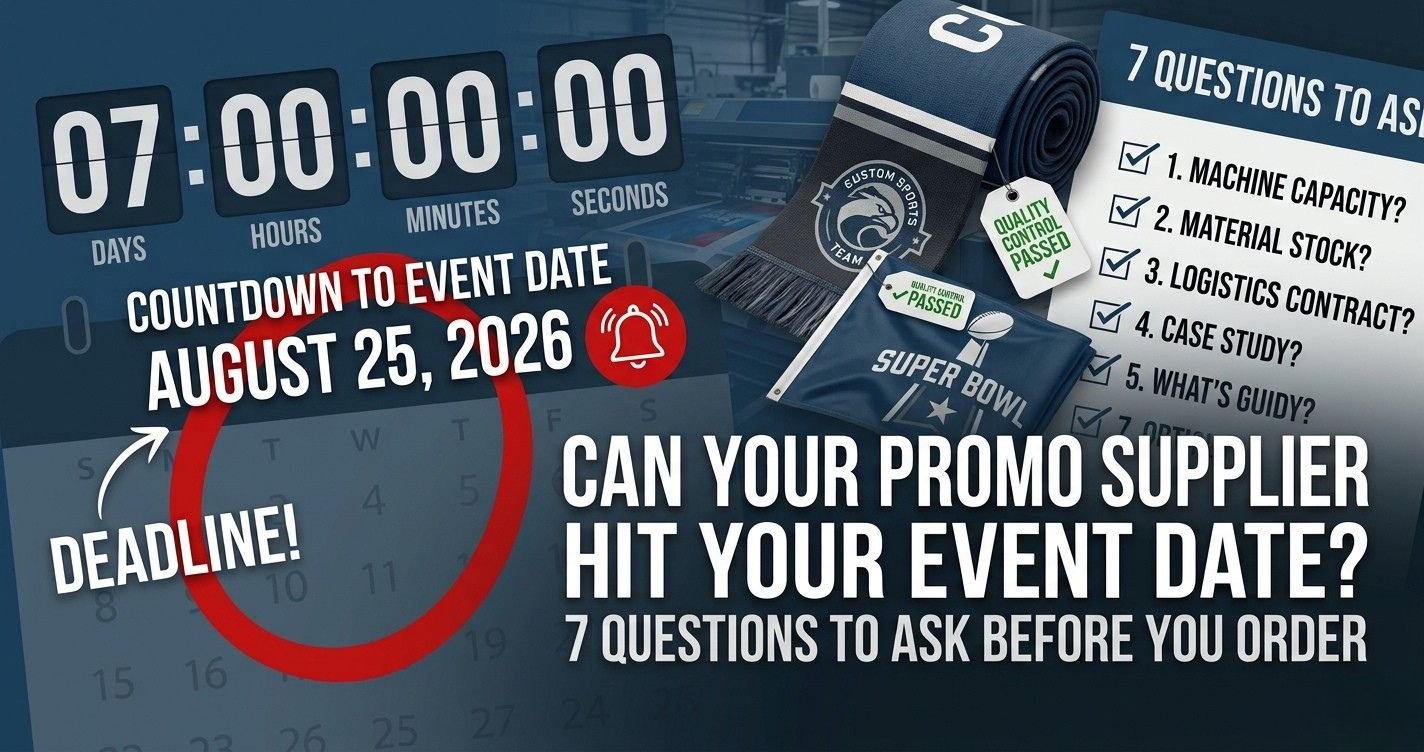
Every sports promo buyer has a version of this nightmare: the order is placed, the event date is locked, and the supplier promised three weeks. Two weeks pass. The supplier goes quiet. Then comes the message nobody wants to read: “Production is running a bit behind — can we ship five days later?”
Five days late. On a fixed event date, that’s not a delay — it’s a failed activation, a wasted budget, and a very hard conversation with your boss or client.
The uncomfortable truth is that most suppliers quote lead times they hope to hit, not lead times their operation can prove it can hit. The good news? You don’t need to take anyone’s word for it. There are specific, verifiable answers that separate real capacity from empty promises. Here are the questions to ask — and what a trustworthy answer actually looks like.
Why “Promised” Lead Times Keep Failing
Before we get to the questions, understand why this happens. A lead time is only as real as three things a supplier controls:
- Production speed — how much product they can actually make per day
- Inputs — whether raw materials are on hand or must be ordered from scratch
- Logistics — whether they can physically get the goods to your door on time
The industry default is painful: most suppliers order materials after you order from them, run a standard print-and-sew cycle of 20+ days, then hand your freight to a spot-market carrier with no guaranteed space. Add a 25–35 day ocean shipment, and a “6-week order” quietly becomes a “hope it lands in time” gamble.
That’s why asking “can you do it in 3 weeks?” is the wrong question. The right question is: “What exactly in your operation makes 3 weeks possible?” If the answer is a shrug and a smile, keep reading — here’s what to ask instead.
The 7 Questions That Reveal Real Capacity
Ask these of any supplier, including us. We publish our answers because we’d rather earn your order on evidence than on a promise.
1. “How many production machines do you run — and how many are actually in use right now?”
This is the single most important question. Machine count tells you peak capacity; utilization tells you available capacity. A factory with 3 machines at 100% utilization is slower than a factory with 25 machines at 60%.
- Green flag: A specific number, plus honesty about current workload.
- Red flag: “We have plenty of capacity” with no numbers.
(For reference: we run five 15-head digital sublimation printers — that’s how a 140,000-piece rally flag order can be produced in parallel instead of in sequence.)
2. “Do you keep raw materials in stock? Which ones, and how much?”
Materials are where the biggest hidden delays live. If a supplier has to order fabric, wait for weaving and dyeing, then wait for shipping to their factory, you’ve already lost 2–3 weeks before a single flag is printed.
- Green flag: A concrete list — “we stock 300,000m of polyester flag fabric in 40+ colors” beats “we have good relationships with mills.”
- Red flag: “We’ll order the fabric after you confirm the order.”
3. “Which logistics partner do you have a contract with — and what does that contract guarantee?”
Anyone can quote a FedEx rate. A supplier with a yearly contract gets guaranteed capacity, priority handling, and better rates — and that contract is what saves you when everyone else is fighting for space in peak season.
- Green flag: A named carrier with a contract and VIP-tier service.
- Red flag: “We use whatever freight forwarder gives the best price.”
4. “Can you share a case study of a similar-size order delivered on time — with dates?”
Past performance is the only honest predictor. Ask for something comparable in volume and complexity, not a marketing story — actual dates, actual quantities.
- Green flag: A specific project you can verify (“140,000 rally flags for the NFL Super Bowl, delivered in 7 days”).
- Red flag: “We’ve never had a problem” — with nothing to show.
5. “Will you send me daily production updates with photos or videos?”
You shouldn’t have to chase a supplier for status. A supplier with a real process sends updates without being asked — photos from the floor, quantities produced, QC checkpoints passed.
- Green flag: Updates are a stated part of the workflow, not a favor.
- Red flag: “We’ll update you when there’s news.”
6. “How do you allocate capacity during peak season? Where does my order rank?”
September through January is crunch time in sports promo. If your order lands in the middle of Super Bowl season, you want to know the factory has a system for prioritizing committed orders — not just whoever shouts loudest.
- Green flag: Capacity is reserved for contracted orders; peak-season commitments are explicit.
- Red flag: Vague answers, or “don’t worry, we’ll make it work.”
7. “Will you put the lead time in the contract — with a consequence if it’s missed?”
This is the question that filters out 90% of suppliers. A written lead-time commitment with a penalty clause costs a real supplier nothing — because they can hit it. A supplier who hedges here is telling you everything you need to know.
- Green flag: “Yes — delivery date in the contract, with remedies if we miss it.”
- Red flag: “We can’t guarantee dates; shipping is out of our control.”
What It Looks Like When a Supplier Actually Has the System
Here’s the thing: these seven answers aren’t theory for us. They describe how we run. When a client asks us for “the perfect item within budget and on an unimaginable deadline,” the answer comes from three interlocking pieces of our operation:
- Equipment: five 15-head digital sublimation printers, each with a 1.9 m print width, run in parallel so large orders are produced simultaneously, not sequentially.
- Inventory: most of our raw materials sit in our warehouse, not in a supplier’s order queue. That’s how we routinely beat competitors by more than 15 days before production even starts.
- Logistics: we’re one of FedEx’s largest local customers with a yearly VIP contract — guaranteed space and preferred rates, even in peak season.
Our capacity, in numbers
515-head sublimation printers
1.9 mprint width on each
3,050 m²/hrcombined peak output
~60,000 m²/daytransfer paper at full load
That’s the equivalent of roughly 37,000 large (3’×5′) flags — or 170,000 bucket hats — every single day. Figures are for our sublimation printing stage; final output also depends on heat transfer, cutting and sewing, which we schedule in-house.
That system is why we could deliver 140,000 rally flags for the NFL Super Bowl in 7 days — and why we’re comfortable putting our lead times in writing. If your event date is fixed, you want a supplier whose capacity is verifiable, not a supplier who just talks fast.
Build Your Own Countdown Worksheet
Even with a capable supplier, you should never discover a timing problem after the order is placed. Work backward from your event date and give every stage a buffer. Here’s the worksheet we use with clients:
| Stage | Normal timeline | Rush timeline | Count back from event date |
|---|---|---|---|
| Design finalization | 1–3 days | 1 day | Event date minus 20–35 days |
| Sampling & approval (digital proof / physical sample) | 3–7 days | 1–2 days (digital proof only) | Event date minus 17–32 days |
| Production | 7–15 days | 4–7 days | Event date minus 10–25 days |
| QC & inspection | 2–3 days | 1–2 days (inline QC during production) | Event date minus 7–22 days |
| Logistics (air express / air freight) | 3–5 days | 2–4 days | Event date minus 4–17 days |
| On-site buffer | 2–3 days | 1 day | Event date |
Two rules for using this worksheet:
- Never plan to the last day. If your event is on the 30th, target arrival by the 26th. The buffer is not optional — it’s where reality happens.
- Know which stage is your biggest risk. For most buyers it’s materials (hidden inside production) and logistics. Ask your supplier specifically how those two stages are protected.
For a deeper dive into the QC stage, see our Digital Sublimation Printing QC Checklist for Custom Sports Flags — and if you’re planning around a fixed game date, How to Plan a Stadium Giveaway When Your Event Date Is Fixed walks through the full planning sequence.
The Bottom Line
Lead time is the one thing you can’t negotiate with a calendar. A supplier’s promise is only as good as their equipment, their inventory, and their logistics contract — and all three are verifiable with the seven questions above. Ask them. If a supplier hesitates, that’s your answer. If they answer with numbers, documents, and case studies, you’ve found a partner who treats your event date as seriously as you do.
Your event date won’t move — but there’s still time to plan it right.
Tell us your event date, quantities, and products, and we’ll come back within one working day with a written lead-time commitment — not a hope. Request a quick quote, or email us at kiteflag@kiteflag.com. We’ve delivered 140,000 flags in 7 days; we’d like to show you what that system can do for your next order.